You can’t achieve success in any area of marketing without taking action.
But it’s possible to take action too quickly.
You want to take action only after you have a solid initial plan to act on; otherwise, you’ll end up doing things that don’t produce any results and only waste your time.
When I see how many marketers approach social media, it's clear to me they don't have a plan.
They randomly connect with users, post things, and sometimes send messages to those users.
By basic logic, random actions lead to random results.
And that’s not what we want as marketers.
Instead, you need a plan. This applies to all parts of marketing, but right now, I want to focus on social media.
Social media is one of the most useful marketing channels there is.
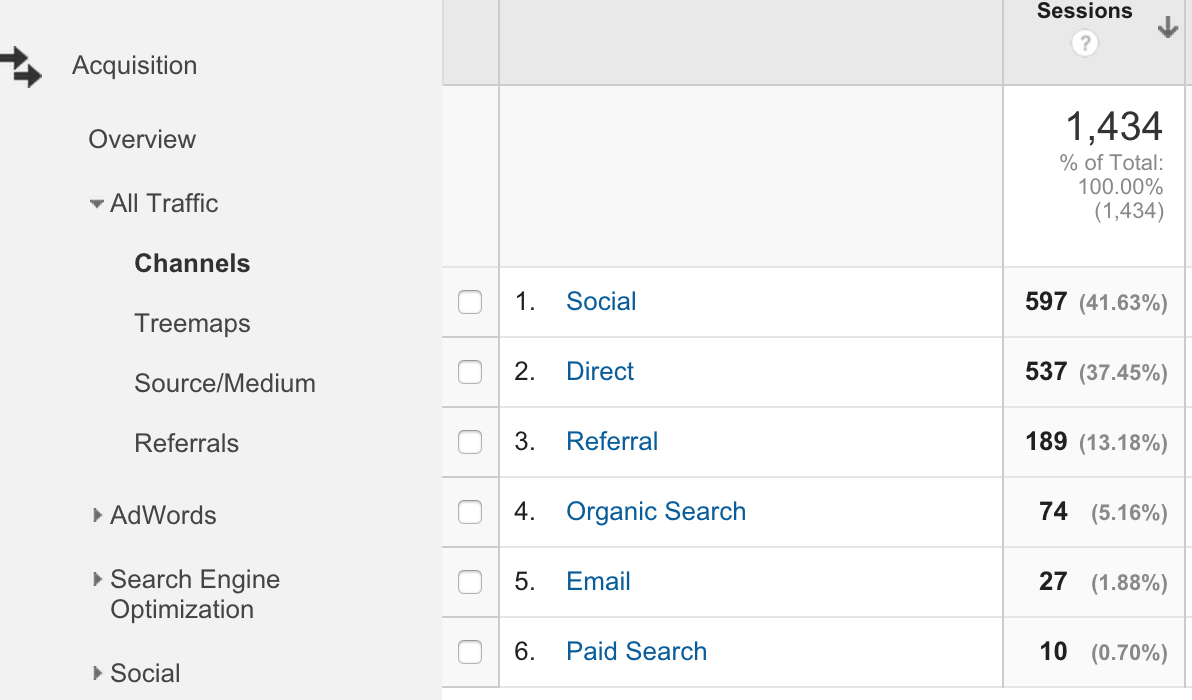
It drives an astounding 31% of overall referral traffic on the Internet.
Since just about everyone uses some sort of social media site on a regular basis, almost every business can find its audience on one of them.
But it’s not easy to get those users to your site. That’s where a complete social media strategy comes in.
On top of that, it’s a great idea to have a social media marketing plan. This is a 1-2 page document that outlines the most important parts of your overall strategy.
It’s a great way to make sure all your actions have a purpose behind them and to have something that will keep you consistent over time.
In this post, I’m going to show you a step-by-step process to create your own social media marketing plan.
Step 1: It’s time to get specific—with whom do you want to connect? (Audience)
Any social media strategy or plan always starts with the audience.
The whole point of social media marketing is to get users from a social network onto your site or to buy something (or both).
It sounds basic because it is, but always keep that in mind.
In order to accomplish that, you typically need to “connect” with these people on a social network. That’s how these sites are built; users form a network with other users.
There are a few questions you need to answer here to complete this first step of your plan.
Step #1 – Who are they? Before you even look at a particular social network, you need to figure out what kind of users you’re trying to target.
Essentially, you want to define your niche.
That’s an important job in its own right. You need to get as specific as possible. If you need help, here are some great resources:
- 4 Proven Steps to Finding a Profitable Niche
- How to Research a Profitable Niche Market: Law of Attraction Case Study
- How to Write Like a Pro in a New Content Niche
After you’ve defined your niche, I want you to start a new Word document.
Create a section there, called "Audience.”
Under that, write down your niche.
It should look something like this:
Intermediate marketers of small- to medium-sized businesses looking to improve the effectiveness of their social media marketing.
The more specific you can be, the better. You’ll be able to target users on social networks who are most likely to be interested in your business.
Step #2 – Where are they? Now that you know the type of user you want to target, you need to find out where they hang out.
In general, you want to stick to the networks that have the largest base of those users because they can sustain long term growth for you. However, short term tactics can work on just about any network if that’s what you’re interested in.
Typically, this means that you’ll stick to the biggest networks:

So, how do you determine which network is best for you?
Well, if your niche is mostly determined by the demographics of your audience, it’s possible to pick a network by matching your information to the demographics of a social channel:

Using that chart, you can see that Pinterest, for example, is a great network for any female-dominated niche.
Or you can see that LinkedIn has the highest average income of any network, which makes it great if you sell luxury products of any kind.
The other way you can go about it is to use a tool like Buzzsumo.
If you type in your general niche (e.g., “marketing”) into the top content tool, it’ll bring back a list of the most popular posts (based on social shares).
Here’s an example for a hypothetical productivity site:

You'll see that one or two of the social networks will dominate the shares of every single article.
In the above picture, Facebook had over 90% of the total shares for each of the top three results.
That’s by far the simplest way to find a good network to target, but keep these two limitations in mind:
- number of networks - Obviously, Buzzsumo is limited to the five biggest social networks. In most cases, this is fine. However, just because a network isn’t on the list doesn’t mean it can’t be a place where your target audience hangs out.
- specificity of articles – When you type in your general niche, you may get results of articles different from those you produce (so they may attract different audiences). To combat this, search for different terms until the results look like the content you usually produce.
Step #3 – With whom are they connected? The final thing you need to figure out is with whom your target users are connected.
Remember that, by definition, social networking sites involve users building a network with other users.
People typically follow those users with whom they have something in common.
The easiest way to find the users you’re looking for is to find people who already work and influence in a similar niche because they will be connected to your target users.
To do this, head back to Buzzsumo.
This time, use its influencers search tool. Type in a few general keywords that describe your niche, and you’ll get a list of people who are well known in your niche:

Sort these by followers, and write down 25-50 of these names.
At this point, your audience section of your social media marketing plan should contain:
- a clear definition of your niche and the people you want to connect with
- the names of the specific networks you will be using
- the names of 25-50 influencers that your target audience is connected to
Once you’ve done that, you can move on to Step 2.
Step 2: What are the commandments of your chosen networks?
Your plan needs to tell you not only what to do, but how to do it.
Create a new section in your document titled “Best Practices.”
The goal is to specify the do’s and don’ts of the networks you’ve chosen.
The users of all networks act in a particular way; they form a “hive mind.”
If someone else has to execute your social media marketing plan, every detail needs to be clear, including how to act on the network(s) you’ve chosen.
If it’s a network you already use, this is fairly easy. But if it’s a new network, chances are you won't just “get it.” Everyone passes through this phase at the start.
And to get past it, we’ll have to do a bit of research.
Some sites, such as Reddit, have a list of posting rules and best practices:

Many, however, do not.
Instead, you have two main options.
The lazy option is to simply Google something like “best practices for using [social network name].”
Chances are you’ll find a few good resources that summarize this information for you:

The non-lazy way, which is best, is to do a bit of research on the network itself.
Remember that list of users in your niche that you made in Step 1?
These guys have already proven that they know how to use the network effectively. You can learn a lot just by spending 5-10 minutes studying their activities.
Start visiting their profiles one by one on the network you chose.

On this Twitter profile, two things jump out right away.
First is the description.
It’s clear that hashtags (#) and user tags (@) should be used on Twitter when possible.
It’s also clear that Michael has posted a lot of photos and videos. From that, you could learn that Twitter posts with visuals perform best.
Clicking the photos and video links reveals that many of his pictures are real life pictures (as opposed to custom-designed images or screenshots).

Going back to his profile, we can learn even more.
Looking at Michael's posts, we can see he posts at least 2-3 times per day. I would note this down and compare it with the other influencers.
Additionally, he uses proper grammar along with casual words (e.g., “duh!”) and sarcasm (e.g., it’s all Elon Musk’s fault!).

The key here is to look at 10 or more people on your list and get an overall picture of what type of things matter the most.
If you see that everyone posts multiple times a day, you probably should too.
By the end, you want to make a few conclusions about the best ways to act on the network. The following areas are the best to start with:
- How do they type? – look at how good their grammar is and how casual their language is.
- What content do they post? - images? videos? just text?
- Are there any special features that could affect your behavior? – this will vary from network to network. For example, Twitter has hashtags, limited post length, and even live video streaming with Periscope.
Once you answer these questions, you can create a list of “commandments” for your network and add it to your marketing plan.
Step 3: What is your proposition? (i.e., why should they connect with you?)
Your goal on any social network is to connect with your target users.
In order to do that, you need to understand why users connect with each other on social networks.
Many things go into a user’s decision here, and it’s your job to maximize the attractiveness of your profile.
On most social platforms, there are three main areas of a profile:
- “about” – which contains a personal bio and any other personal information
- statistics - which contains information on your connections (e.g., how many you have)
- your posts - your most recent posts on the site
Here’s what it looks like on Twitter:

Let’s start with your follower count.
Users follow other users for one of two reasons:
- they know them
- they look popular (social proof)
Obviously, you’ll be connecting with many people you don’t know. It helps enormously to have tons of followers. Those followers tell every other user that you are worth following—they act as social proof.
When you first start, you aren’t going to have many followers. Getting followers initially will be harder than later on.
There’s nothing you can do about this other than to accept it and understand that it will get easier.
Buying fake followers is rarely a good solution as it leads to a low engagement rate. On some networks (such as Facebook), it can actually hurt you.
The more important areas to optimize are the other two.
Crafting a compelling biography: You typically have a very limited amount of space for biographies on social networks, so use it wisely.
It’s one of the major things a user will look at when deciding if they want to follow you.

Because you have limited space, you can’t really overwhelm users with your accomplishments.
There are two parts to it:
- what you’re interested in - a quick sentence that describes the topics that you typically post about. Example: “I’m an entrepreneur who likes to blog.”
- why should people care about what you have to say - the rest of your biography should be dedicated to listing things that your target users care about the most. For me, that’s “I have started two SaaS analytics companies.”
The first line tells them whether we have shared interests, and the second part seals the deal. Most of my readers would love to start their own companies (or build theirs up), so mentioning my two successful companies shows that I have something to offer.
Don’t get cute and start talking about your pet cats; focus on your most impressive accomplishment(s), keeping in mind the perspective of your target users.
Post awesome stuff: Duh, right? But it needs to be said, and that's why we dedicated part 2 to learning how to post effectively on your chosen network.
Users will see your most recent posts. If they think, “Cool, I’d be interested in hearing more from this guy,” they'll be likely to follow you.
That means you have to continuously post things that your target users love.
You will do that by choosing posting tactics in your overall social media strategy.
Go back to your sheet, and add a new section called something like “Value Proposition.”
Underneath it, create a bio that describes both what you’ll be posting about and why users should listen to you.
In addition, write down any other reasons why a user might want to follow you. For example:
- posts high quality images
- posts frequently
- offers free stuff and contests regularly
Step 4: How will you position yourself against other businesses?
If you come along and start a site just like Quick Sprout, what do you think my users on social media will think when you ask them to follow you?
Pretend you have an almost identical profile and post about the same topics.
Well, most users will decide that they already get enough of that content from me, and they have already built some sort of a relationship with me. So, why would they need to follow you?
But what if you didn’t post the same things? What if you didn’t write at all, but produced high quality videos or podcasts instead?

Now, you have something worth following you for.
Those names that you collected before are your competitors.
If you narrow your niche further down, that will help you stand out a lot. But on top of that, you want to find a way to distinguish yourself on the network so you don’t look like just another copycat.
Important note: Earlier, I told you to study these competitors to learn about the basics of using the network. Now, we’re looking for ways to stand out from these competitors. These are not contradictory.
You’re still going to follow all the basic rules, but you’ll just try to find a way to be more appealing to your target users.
Your approach won’t always be better, but it will be different.
So, how can you stand out?
Don’t be afraid to be creative, but here are a few ideas:
- post content in different formats – be the first to adopt the latest supported content form (like Periscope on Twitter for live video)
- post things related to your niche - instead of publishing just marketing-related information, I also post inspirational quotes of sorts that my audience loves. Not all influencers do this.

- post behind the scenes information - users are always curious and love getting exclusive access. Be more transparent and show what work went into your personal projects (that you later publish in posts).
On your marketing plan, add a line or paragraph that states how you stand out from your closest competitors.
The crucial part here is having at least one reason for a user to follow you that none of your competitors can provide.
Step 5: Your growth strategy
Now that you know which users you’ll be targeting, your next step is to determine how you’ll actually connect with them.
As you grow your network, it will get easier and easier to keep growing it.
At first, however, it can be difficult, and you need a concrete plan that will consistently grow your followers.
In general, there are three different types of social media growth strategies.
Option #1 – Use the reciprocity principle: When you do something nice for someone else, they’re likely to try to return the favor; it’s called the reciprocity principle.
According to Robert Cialdini’s research on the principle,
Favors are typically returned in like (meaning the same way if possible).
This means if you follow someone on a social network, they are likely to follow you back.
And that’s a strategy you can use on many major social networks. It is commonly used on Twitter, Pinterest, Instagram, and others.
The idea is to follow as many of your target users as possible. Usually, around 10% will follow you back (sometimes more or less). Then, you just check a few days later and unfollow anyone who didn’t follow you back.
There are a few important things you need to know about this strategy.
The first is that there are usually limits to the number of users you can follow per day or in total:

The second is that you can use tools to automate this process. Enter hashtags or the names of users who have the followers you want, and the tool automatically follows and unfollows them for you:

Sounds awesome, right?
Unfortunately, most networks will suspend or ban your account if they catch you doing that.
If you’re going to use automation tools like these, try not to follow too many users at once to avoid raising red flags.
When possible, do the process manually (you can still use tools to find the users you want to follow).
Finally, you can actually improve your follow-back rate by changing one small thing in this process: only target users with recent activity on the network.
There are three main reasons a person won’t follow you back:
- they’re not interested
- they don’t want to follow people associated with businesses
- they’re not active on the social network anymore (very common)
The third one is the only one we can do anything about. If you make sure that the user has recently posted something on the network, it shows that they are still active on it.
Option #2 – Followers can be bought: It sounds kind of wrong, right? But it’s true. When you pay for advertising on a social network, you’re essentially buying followers.
I’ll be honest with you, advertising is by far the fastest way to establish a decent-size follower base on any social network.
In addition, it’s usually pretty cheap, and you can typically get new followers for a few cents each ($0.05-0.20 on most networks) once you optimize your campaigns a bit.
You could spend a few months getting your first 2,000 followers, or you could just spend $100 (or less) and have them in a week.

This is worth it for almost every business.
Option #3 – Find followers in groups: The final main growth option is to join groups. Most social networks, including Facebook, LinkedIn, and Pinterest, have groups of some sort.
These groups usually have thousands of members interested in a particular topic.
For example, you can search for a keyword on LinkedIn, e.g.,“marketing,” and find several groups with thousands of members (use the “groups” filter on the left):

Inside the group, people make posts about the group topic, and other members of the group can view and engage with those posts:

You can use groups as a place to find your target users and just follow them (option #1).
Or you can try to engage with posts in the group and eventually make some really good ones of your own.
If you post something really thoughtful, you’ll often get several connection requests as a result.
Time to write it down: You can use as many strategies as you’d like to get followers—they all can work together.
Go back to your marketing plan document. Add a section for “Growth Plan,” and then add whichever strategies you’ve chosen, along with their descriptions.
For example, you might write:
Growth plan (user acquisition)
Advertising
Details: Advertise our business page to the followers of our competition. Budget: $10/day.
Step 6: Your conversion strategy
If you follow your plan so far, you’ll know who and where your audience is, and you’ll have a way (or a few) to start adding those users to your social network.
Combined with your network commandments you came up with earlier and your positioning, you know how to post things that these users will enjoy.
It’s always a good idea to grow your followers as aggressively as possible.
But what you will also notice is that once you get a few thousand followers or connections, you will start getting more of them organically. As you share great content, your followers also share it with their followers, and some of those people will want to connect with you.
And that's how your social presence and reach will continue to grow.
Now comes the most important part:
How is this going to help your business?
You’ve identified users who might be interested in whatever you sell, but now you have to find a way to get that offer in front of them.
There are two main ways to do this.
Option #1 – Send users to sales pages (aka the bad way): I’m not going to spend much time on this option because it doesn't work well in the vast majority of cases.
If you post a link to a sales page, very few of your followers will click through to it even if the product might be useful to them.
The main reason for that is they’re in the wrong frame of mind.
People are on social media to stay entertained and get informed, not to buy things.
I strongly recommend you choose Option #2 instead.
Option #2 – Send users to landing pages and content: The big question becomes: "How do you get users into the buying frame of mind?"
The answer is to shift the conversation to a different medium. In particular—email.
People are more than willing to go to sales pages from emails because they approach emails with a completely different mindset.
Your main goal, then, is to get your followers from social media onto an email list.
One option is to post a link to a landing page that has a lead magnet on it.

A good landing page converts at a high rate, sometimes over 50% if the offer is really good.
The more common way to convert social media followers into email subscribers is to send them to your blog content.

Obviously, most blog posts won’t convert as highly as a landing page. On the other hand, your visitors will enjoy the visit more, and your brand will become more likable in their eyes.
More importantly, since they are your followers on a social media platform, even if they don’t convert the first time, you’ll get many more chances to offer them that opportunity.
Go back to your sheet now, and add a section for “Conversion Strategy.” This only needs to be a line or two about how you will turn your social followers into customers.
For example:
Conversion Strategy
Send followers to blog posts that have email opt-ins.
Send an email sales sequence that introduces our product and gives them a chance to purchase.
Conclusion
The top social media sites have millions of users (billions in some cases).
I guarantee that you can find the people in your target audience on at least one of these sites.
If you want to use social media effectively for marketing, you need a plan. And that’s exactly what you should have at this point.
If you’ve written down the things I asked you to in these 6 steps, you should have a simple, clear social media marketing plan (1-2 pages max) that only contains the essentials.
Once you have this, you can flesh out the tactics you will use by creating a detailed social media strategy.
Finally, this plan doesn’t have to be set in stone. If something isn’t working as well as you thought it would or you have an idea to improve your plan, change the plan.
If you have any questions or don't mind sharing your social media plan with others (for a critique), please do so in a comment below.