Thursday, March 3, 2016

How to Execute Event Marketing like a Data-Driven Machine

We know you’re a data-driven marketer – a thoroughly Modern Marketing Maven. You have put together a powerful arsenal of marketing tools which include:  


  • Customized emails to nurture prospects through their buying journey, with nurturing tracks and lead scoring to tell you which ones are hot and which are not.

  • Content marketing assets, both static and video to engage, educate and inspire your readers.

  • SEO, pay-per-click and social programs to ensure that your messages are heard by your intended audience.


And of course, you’ve integrated those workflows so that Sales has the information to reach out to the right contact at the right time to achieve their goals and make happy customers out of curious contacts. Because you value data-driven decision-making, you’ve merged the data from each of these channels to inform your actions and evaluate the effectiveness of each campaign.


But what about events? While you and your sales team know events are a great way to interact with current and future customers, you still have no way to use the data collected at these events to drive campaigns. Nor do you have a way to attribute revenue to this resource-intensive marketing investment, or to show ROI from events. Like most B2B marketers, 30% of your marketing spend is allocated to events, but if you’re not sure if you’re maximizing the effect of this critical marketing tactic, you are not making the best use of the data collected with events, and you don’t have line of sight into the impact of these events.


This brings up two important questions: what steps can you be taking so that your event and marketing automation systems are in-sync and you capture valuable attendee insights? And secondly, what are the essential elements of the event lifecycle and how can you measure event success?


To help you answer these questions, we’ve developed an event marketing infographic so that you can see how you can leverage the data from events, prospect data from your marketing automation system, and customer data from your CRM system to accelerate sales, engage attendees, inform your marketing decisions, and demonstrate ROI for events. This infographic illustrates the relationships between systems before, during and after the event, and this information will help you craft your data strategy and attendee engagement approach so that you can do event marketing like a data-driven machine. (Click the link above or this box to view the infographic).


Click to view infographic


Stakeholders work together to define your audience and event objectives

Not all attendees are created equally, nor do they all have the same objectives. So you’ll want to identify your target audience: is your event designed for customers? Prospects? Partners? All of these? “Big tent” events typically include a wide variety of audience types. If this is the case for your event, you’ll want to ensure that you have specific definitions of success for each of those audiences. In addition, different stakeholders within your company may have different definitions of success, so giving yourself plenty of lead time to bring those stakeholders together to agree on success metrics will be critical.


The same can be said of event stakeholders – they may have different definitions of success as well. Stakeholder types for a big event may include: Sales, Marketing, Customer Success, Professional Services, Business Development, Product Management and others. Smaller events may include a subset of these. For either type of event, work with stakeholders to define different buying journeys for the attendee types which are of greatest interest to them. Then, define success for those attendee types.  


For example, Sales will want to convert prospects to customers.  They will focus on prospects who are far along in their buying journey. So, this stakeholder type will be measuring revenue.


Customer Success may be working towards customer satisfaction or cross-selling to an existing customer. Product Management may be seeking customer feedback with the ultimate goal of increasing NPS scores or additional product adoption. And of course, Marketing will likely define success in terms of number of leads.


Deliver a customized pre-event experience

Start with your marketing database of record to segment according to your intended audiences. This could include prospects, existing customers, various partners of all types, event sponsors, VIP’s, event staff and other employees. You will do your segmentation here and customize each message to the attendee type and their pre-event interactions. This is where the richness of your event data begins. Since registrants are typically more willing to share accurate information for an event than they are for other marketing channels, take this opportunity to ask questions regarding their preferences, use updated profile information to refresh your marketing database profiles, track who views your promotional video content and capture custom agenda items as your attendee builds their agenda – these are all interest indicators and buying signals!


Use customized landing pages for each participant type as well. Think about using profile and interest data to define and deliver custom-generated content as well as video to engage your attendees and build excitement around the event. Let your attendees “pre-build” a customized agenda by using a mobile app as a way to personalize the experience and allow you to collect more data prior to the event. Pre-schedule meetings during the event based on this information.


The big day is here!

At the event, collect attendee interest indicators and buying signals. These are collected through the initial badging process, badge scans at sessions, check-ins at pre-scheduled meetings, specific product areas or micro-events, badge scans at booths, at-event surveys at kiosks, polling questions during sessions, and appointment scheduling using your event app. Push this data into your marketing automation system so that you can take action in real time: request a follow-up appointment from the attendee, alert Customer Success of an unhappy user that they need to contact, text Sales that a prospect is broadcasting buying signals and to get to the meet-up location (stat!) to do an on-the-fly demo, notify the attendee of related sessions or assets related to their expressed interest, moving them along in their buying journey.   


After the event

Link your marketing database to your event management solution. Of course, your Marketing Automation system receives all this detailed data from the event management system. Now you have enhanced profile information for your attendees as well as interest and engagement data to use for lead scoring and nurturing as well as for analyzing the effectiveness of the event.


After the event, use all the information and interest signals to move your prospect through the sales cycle.  Do you need to reach out to schedule a demo, offer a related product or service, arrange a little more face time? The information gleaned about prospects at an event add color and texture to a prospect whose needs and interests could be otherwise somewhat opaque.  


So that Sales has all this “profile plus” information at their fingertips you will want to ensure that your marketing automation and CRM systems are synchronized in real time as well. Some organizations structure their marketing data architecture differently and maintain a master marketing database of record outside the operational systems of marketing automation or CRM, and synchronization of all operational systems is to that database. That works too!


Back to your attendee - since you have such good information about your attendees, you can send customized follow-up, rather than a generic “thank you.” Do thank them, but create value by including relevant information, advice, or recommendations.


Finally, do the analysis. What’s the ROI for the event? Because it’s all linked to specific prospects and you have included events in the map of each customer’s journey and tied it to revenue, you can include that event spend into your attribution model with all your other marketing activities. The result is credible ROI than can drive decision for future marketing investments.


Your events are no longer cost line items, they’re investments with a proven return and you have line of sight into the impact of all your marketing programs — whether digital marketing campaigns or face to face events.  So start planning your next event like a data-driven machine!


Since marketing automation is a key part of this data-driven process, download the Marketing Automation Simplified guide to get your machine up and running.


The Ultimate Guide to Removing Google Analytics Referral Spam

It started out simple enough with semalt and buttons-for-websites. Then the ilovevitaly attacks began. Pretty soon Ranksonic began mocking us with fake events and organic search terms. Before we knew it there was a full-frontal assault of fake referral spam masquerading as legitimate website visitors compromising the accuracy of our Google Analytics reports. We all knew Google was working on it, a definitive solution just never came.


The problem was, and still is, most marketers don’t know what referral spam is, how to spot it, or how to remove it. This presents a major problem when businesses and marketers begin using these inaccurate Google Analytics reports to make conversion rate optimization decisions on A/B tests, landing page optimization, and more.


Worse yet, many marketers are unknowingly presenting traffic numbers to bosses and stakeholders that could be off by up to 60%!


Thankfully, there are a few proven strategies to eliminate Google Analytics referral spam. In this article we’ll discuss what referral spam is, how to identify it in your reports, and I’ll show you a few tried and true methods to clean up historical reports and prevent referral spam from effecting reports in the future.


What Is Referral Spam?


The majority of referral spam never actually visits your website which is why some marketers refer to it as “Ghost” spam. Even though this traffic never visits your website it still appears in your reports as legitimate traffic affecting total sessions, bounce rate, time on site, conversion rates and more.


On a major website where hundreds of thousands of sessions are recorded on a daily basis this traffic isn’t a major concern. On small business websites, this traffic can account for over 60% of daily sessions which causes major problems in month-to-month reporting, A/B testing, or other conversion rate optimization tests.


If this traffic never visits your website, why does it show up in Google Analytics? Google provides a developer tool called the Measurement Protocol. Among other legitimate uses, this allows developers and businesses to track behavior of their customers from a wide variety of different offline data sources and send that raw data to their Google Analytics account.


Unfortunately, this also opens the door for crafty spammers to force raw data into Analytics accounts by randomly attacking UA tracking codes, completely bypassing the website.


referral-spam


How Do I Identify Referral Spam?


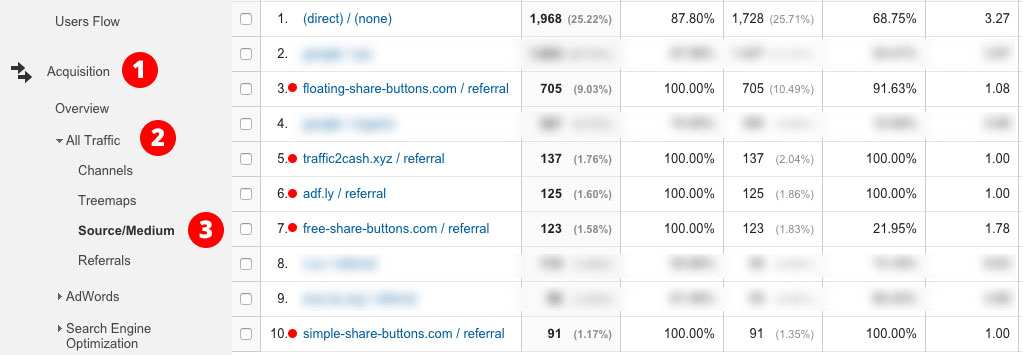
There are a lot of ways to identify referral spam but the quickest is to review your traffic reports by clicking Acquisition > All Traffic > Source/Medium.


source-medium-report


If the referring domain URL isn’t a big enough giveaway of the traffic source being spam, simply visiting the URL should remove all doubt.


Though some of these spammers have gotten more sophisticated, looking at % New Sessions, Bounce Rate and Pages/Session metrics are also a good indication. These metrics will usually be 100%, 100% and 1.00 respectively, another sign that this traffic never visits the website.


How Do I Remove Fake Traffic From Google Analytics?


Let’s be honest, there are thousands of blogs on this topic. Many are out of date, a lot include workarounds that simply don’t work, and others only eliminate some of the spam. What I’m going to outline below will work 100% of the time on new and old accounts. The only catch is you will need to update these filters as new spam domains continue pop up. Unfortunately, until Google provides a solution, there is no permanent “set and forget” fix for this.


Let’s get started.


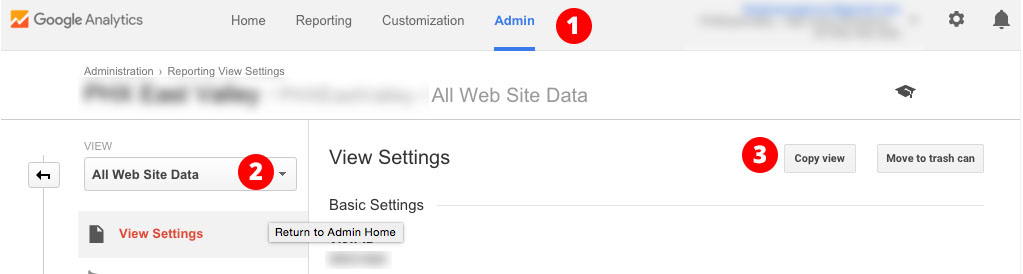
My first recommendation, and I strongly recommend this, is to create a copy of your existing view. This copied view will remain untouched and unfiltered. This is a good safety net in case one of your filters begins filtering out legitimate website traffic.


To copy your primary view, click the Admin tab, select the view you’d like to copy and click Copy View.


copy-analytics-view


The first three filters we’re going to add will block all future traffic from domains which are currently known to send referral spam.


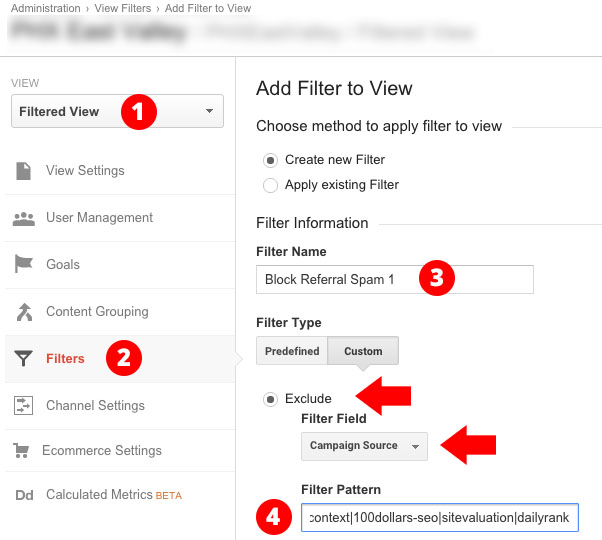
To add our first filter click the Admin tab, select your Filtered View, click Filters, and enter a name for your filter keeping in mind there will be several.


Now this step is very important. You must select Exclude and choose Campaign Source. Many people fail to choose Campaign Source and can’t figure out why their filters aren’t working.


In the Filter Pattern field, copy and paste the string below:


dailyrank|100dollars-seo|semalt|anticrawler|sitevaluation|buttons-for-website|buttons-for-your-website|-musicas*-gratis|best-seo-offer|best-seo-solution|savetubevideo|ranksonic|offers.bycontext|7makemoneyonline|kambasoft|medispainstitute


add-referral-spam-filter


Since there is a character limit to the Filter Pattern field, we need to create a second filter the same as the first, except in the Filter Pattern field paste:


127.0.0.1|justprofit.xyz|nexus.search-helper.ru|rankings-analytics.com|videos-for-your-business|adviceforum.info|video—production|success-seo|sharemyfile.ru|seo-platform|dbutton.net|wordpress-crew.net|rankscanner|doktoronline.no|o00.in


… and a third filter like the previous two using:


top1-seo-service.com|fast-wordpress-start.com|rankings-analytics.com|uptimebot.net|^scripted.com|uptimechecker.com


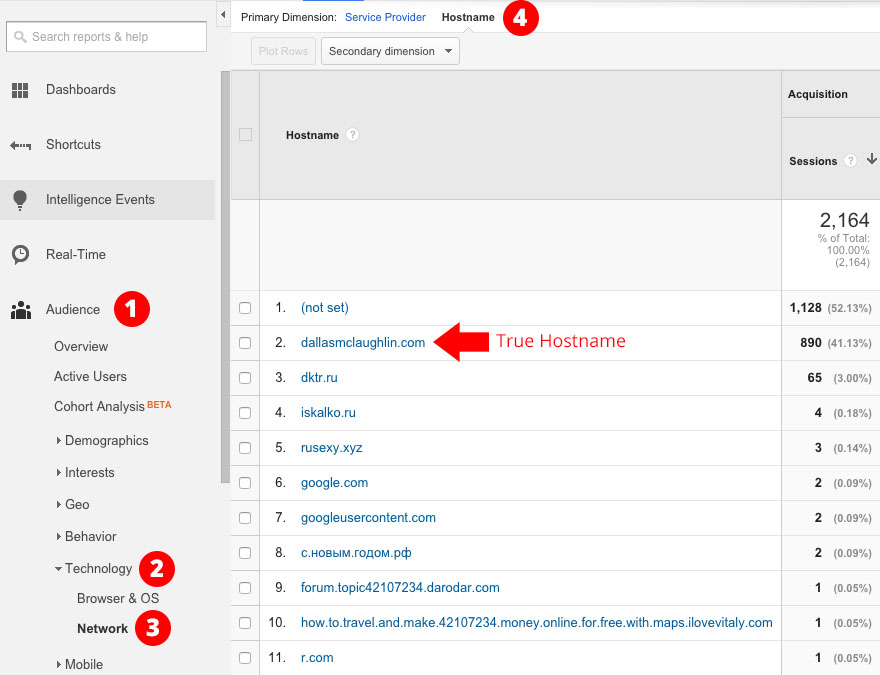
The fourth and final filter we are going to create is a Hostname Filter. I mentioned that the far majority of this traffic never actually visits your website, thus, it never requests your actual hostname which is the URL used to reach your website (typically your domain name).


This can be seen in your Network report by clicking Audience > Technology > Network and selecting the Hostname tab.


true-hostname


Any traffic in the above screenshot that is not visiting my actual URL is spam. Almost 60% of all traffic! The Hostname Filter eliminates this spam from your reports by including only the traffic that reaches your website by requesting your actual domain name.


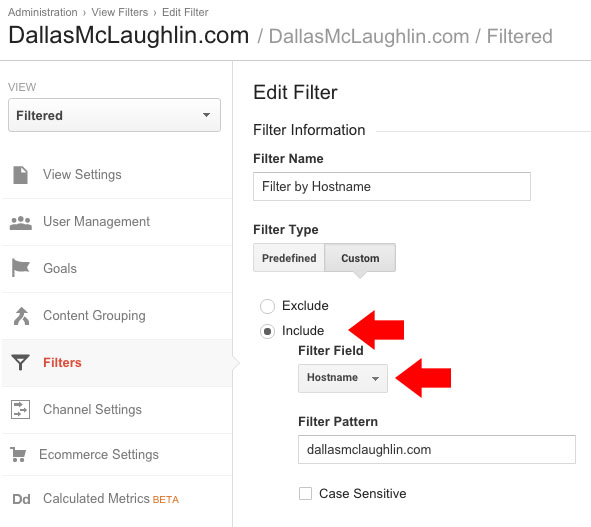
You create this filter much like the previous three. The difference here is you must select Include, choose Hostname for the Filter Field and enter your hostname in the Filter Pattern.


creating-hostname-filter


Congratulations! These four filters have just eliminated 99.9% of all referral spam from your future reports! Routinely adding new domains to the referral spam filters will keep this traffic under control and keep your future reports clean.


How Do I Clean Old Google Analytics Reports?


While the above mentioned filters will only fight future referral spam, you can still remove spam from historical reports using a single Custom Segment.


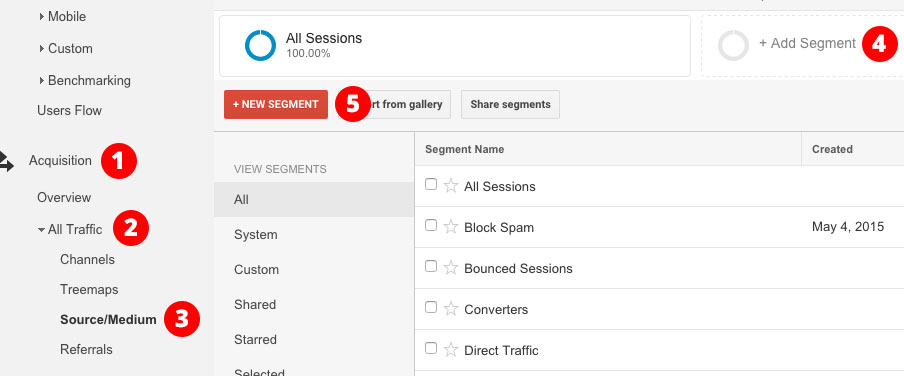
You can create a Custom Segment from any report, but I’d recommend going to Acquisition > All Traffic > Source/Medium. Once there, click + Add Segment > + New Segment.


create-custom-segment


Essentially we’re just going to recreate the four filters we created above, but as a single Custom Segment.


Click Conditions, and on the first filter select Hostname > Matches Regex and enter the hostname(s) you used in your fourth filter above.


Now we want to click the + Add Filter button.


Custom Segment filters default to ‘Include’, but it is very important that your second set of filters be changed to ‘Exclude’.


In the set of drop downs select Source > Matches Regex and paste the same list of spam domains from the first filter you created. Click the OR button and repeat this filter two more times with the respective list of spam domains.


custom-segment-detailed


If the Custom Segment you created matches the screenshot above you’ll notice the circular graph to the right reflect a smaller amount of traffic. This is the amount of site traffic that remains after all referral spam has been removed.


Once you save this filter, you can apply it to any report and any time frame.


Taking The Fight To The Spammers


Nothing can compromise an otherwise successful A/B test quite like inaccurate reporting. With these four filters created and your Custom Segment applied, you can ensure that the data you are basing important marketing decisions on is truly accurate.


Until Google releases a definitive solution to referral spam, bookmark this article and reference this as the most accurate and up-to-date guide on how to finally remove Google Analytics referral spam from your marketing reports.


About the Author: Dallas McLaughlin is a Digital Marketing Specialist at The James Agency, a full service advertising agency in Phoenix, Arizona. He blogs frequently at DallasMcLaughlin.com about Search Engine Optimization, Pay-Per-Click, and Social Media Marketing trends. If you have any questions, you can tweet him directly at @BossDJay.


Smartphone Ownership Just Shy Of 80 Percent In comScore’s New Numbers

We should see 85 percent smartphone ownership by Q3 and more smartphone owners than US internet users some time in 2017.


Please visit Marketing Land for the full article.


6 Landing Page Video Worst Practices to Avoid (And What to Do Instead)

Landing page video

Get fewer conversions now with garbage landing page videos. We’ll show you how! Image by Georgejmclittle via Shutterstock.

Psst! Aaron Orendorff will be speaking at our upcoming Call to Action Conference in June. Get your tickets here!

Not all landing page videos are created equal.


Some are nausea inducing. Others, “heartbreaking works of staggering genius.” (A.k.a. they convert like wildfire.)


Consider the facts:


And given how powerful video is in the online conversion process, “best practice” articles are everywhere…


But this is not one of them.


Instead, here is a list of worst practices. So you know what to avoid.


Why?


Because it’s easy to screw up your conversions with video and waste enormous amounts of time and money in the process.


With that in mind, let’s dive into six ways to make landing page videos that suck… and exactly what you should be doing instead.


1. Don’t educate


As stressed above, videos are one of the most effective tools to propel people toward that conversion.


But there’s a catch.


When Wyzowl surveyed over 230 companies for their State of Video Marketing 2016 study, 72% of respondents reported that video “improved the conversion rate of their website.” That’s up from 57% last year.


However, when those same companies were asked, “What is the primary reason you use video?” a mere 23% actually answered to “increase conversions.”


By a landslide, the number one reason was to “educate customers.” And though this finding applies to websites in general and not just landing pages, it does provide a key insight: A high-converting video is one that’s focused on meeting people’s real needs (i.e., educating them)… not on converting them.


The difference is subtle, but has huge implications. If your goal is to simply “get the click,” your video will reflect that. It’ll inevitably be about you and your product, you and your service, you and your email list, you and your social media account, you and your…


You get the idea.


If you want your landing page video to suck, then don’t educate your audience.


If you want it to shine, then teach your audience something valuable.


Sticker Mule, for instance, takes an educational approach with its video:


Sticker Mule video

In less than a minute, Sticker Mule subtly creates demand by presenting its “transfer” stickers — also known as “vinyl-cut stickers or vinyl lettering” — as a medium for your most intricate designs.


Namely, Sticker Mule educates its audience about how “after one year of research and testing [its] developed a one-of-a-kind process” that not only reduces cost but makes application easy. As pointed out, you “Simply remove the backing, set it on the surface, rub it, and then slowly pull the transfer tape off to reveal your design.”


In other words, Sticker Mule teaches its audience exactly how to use the product, with an emphasis on simplicity and durability. And as Sticker Mule CEO Anthony Thomas told me, “After adding this video to our website, we saw our conversion rate go up by 17%.”


This same fundamental principle lies behind Unbounce’s new series, The Landing Page Sessions.


Landing Page Sessions page

The videos are about how to use landing pages to capture leads… and not only is there a call to action on the page itself (“Send me new episodes”) but also the videos capture leads using Wistia’s Turnstile email collector. (I’ll say more about CTAs in point four.)


For now, here’s a snapshot of the latest numbers for The Landing Page Sessions:


LPS stats

Even more impressive than views, however, are the conversions. When the first video was less than a month old, Wistia reported, “Thus far, with three released episodes, [the] campaign’s videos have received over 3,000 views and captured over 600 email addresses.


2. Don’t make it simple


If you want your landing videos to suck, then go for complexity.


Complexity can take many shapes: technical complexity, messaging complexity, production complexity…


Consider telaFirm, the now out-of-business telephone verification service:


Notice the jargon-heavy language in response to the question, “How do I get started?”: “Verification is easy for you and your customer. telaFirm’s service is integrated into your existing website via a convenient, platform-independent API.”


In addition, instead of focusing on a single problem, a single solution and therefore a single call to action, the video attempts to pack an explanation of all telaFirm’s services into 2:22. For instance, at 1:28 they introduce “PhoneTrace,” and again rely on unnecessarily complex and technical language: “Another telaFirm advantage is the optional ability to detect and block VOIP numbers through our PhoneTrace solution …”


While initially seductive — especially if you’re going for depth — complexity is a conversion killer. It confuses, overwhelms, dilutes value and doesn’t give your audience a compelling reason to act.


The antidote is simplicity.


And this is true across the board. After surveying more than 7,000 consumers and interviewing hundreds of marketing executives and other experts globally, Harvard Business Review discovered that what makes consumers sticky — “that is, likely to follow through on an intended purchase, buy the product repeatedly, and recommend it to others” — is one common characteristic:


We looked at the impact on stickiness of more than 40 variables, including price, customers’ perceptions of a brand, and how often consumers interacted with the brand. The single biggest driver of stickiness, by far, was “decision simplicity” — the ease with which consumers can gather trustworthy information about a product and confidently and efficiently weigh their purchase options. What consumers want from marketers is, simply, simplicity.


The king of video simplicity is Dropbox. Here’s exactly what its first landing page looked like:


Dropbox video

Taking it back. Way back. Image via Wayback Machine.

What’s more, the original explainer video used wasn’t fancy at all:


As TechCruch drove home back in 2011:


The video is banal, a simple three-minute demonstration of the technology as it is meant to work, but it was targeted at a community of technology early adopters … If you’re paying attention, you start to notice that the files he’s moving around are full of in-jokes and humorous references that were appreciated by this community of early adopters.


Drew [Houston, founder and CEO of Dropbox] recounted, “It drove hundreds of thousands of people to the website. Our beta waiting list went from 5,000 people to 75,000 people literally overnight. It totally blew us away.”


Fast forward to today and DropBox’s videos are still just as simple — if not more. Now its videos focus more on the customers and how the product itself can simplify their lives with organization, connectivity and storage.


In other words, where telaFirm focuses on the features, Dropbox zeroes in on the benefits.


But what if you have a particularly complex industry or product?


Don’t fret. Even complex ideas can be put into simple terms, especially if you use video.


Take Choozle’s video for example, whose advanced digital advertising tool is explained using simple imagery, focusing on the main benefits and — of course — starting with the pain point and addressing how the company resolves it.


To ensure your video keeps it simple, ask yourself:


  • Am I zeroing in on the benefits rather than the features?

  • If I do include features, is the language easy to understand for a complete outsider?

  • Are there any technical terms that I need to explain… or cut entirely?

  • Does my video center on one problem, one solution and one call to action?


3. Don’t tell a story


The worst thing to do is build your video around your product.


This is profoundly counterintuitive, especially when you consider the videos featured above. But, as Drew Houston explained regarding Dropbox:


To the casual observer, the Dropbox demo video looked like a normal product demonstration, but we put in about a dozen Easter eggs that were tailored for the Digg audience. References to Tay Zonday and ‘Chocolate Rain’ and allusions to Office Space and XKCD. It was a tongue-in-cheek nod to that crowd, and it kicked off a chain reaction. Within 24 hours, the video had more than 10,000 Diggs.


The point is that Dropbox’s landing page video had a host of connection points that resonated with the story its target audience already identified with. This is exactly why the Easter eggs worked. The references and allusions were tailored to reach the company’s target audience by calling subtle attention to the message: “Dropbox is just like you. We love the same things you love. Our story is your story.”


But, how do you create a compelling story when time is of the essence?


To create a compelling story, you need four ingredients: a goal, a hero, a problem and a supporter. The following graphic is a simplified version of what’s known as the Hero’s Journey or the Fairy Tale Model from Storytelling: Branding in Practice:


Storytelling

But what does this look like in an actual landing page video?


Take a look at GetResponse’s introduction to email marketing:


First, the goal or mission: In order to grow, online business need to “build and maintain relationships with people interested in its product or service.”


Second, the hero: The business owners themselves.


Third, the obstacle: Spending money to get visitors only to have them “scroll, click, leave, and never come back.” The video also includes two other common obstacles: lack of time and lack of expertise. However, every obstacle is framed as an obstacle to the original mission.


Fourth, the supporter: Notice that GetResponse is not the hero. Instead, the business owner is the protagonist (at the risk of sounding like a freshman English professor). GetResponse’s only role is to help guide the hero toward the solution, and that’s exactly how each feature is presented — not as an abstract function, but as a key benefit to move the hero toward the original goal.


4. Don’t have a compelling CTA


Compelling CTAs are the holy grail of landing pages… the same is true for video.


The truth is you can have the most educational, story-driven and downright enjoyable landing page video, but without a click-worthy CTA, it’s all for nothing.


To start, your video’s CTA should align not only with the content of the video itself, but also with the landing page. This doesn’t just mean being consistent. More importantly, it means being singular. Naturally, you can have more than one button. But make sure every button has the same driving outcome, and make it incredibly clear what you want the user to do is also at the top of the list.


This is where design principles come in, namely what Oli calls the attention ratio. He explains that an effective landing page should have one goal and just one way to get there. This increases the chances of your lead taking your desired action.


So, what’s this mean for your landing page video? Only give your audience one option. Eliminate all else.


You can use your videos as creative calls to action that promote your best content, guide leads along the buyer’s journey, gain subscribers, bring viewers to your website and even gather their contact information.


To do this, there are essentially two approaches available: off-video CTA and in-video CTA.


Off-video CTA


For the first approach, take a look at Wistia’s landing page. The central goal is to drive leads to request a demo. The team uses their landing page video as a supportive resource to provide educational information, as well as to offer a push toward their goal of getting those demo requests. However, be wary of not using a contrasting color for your CTA, like the one below.


Wistia video

Watch the video. Request a demo. Image via Wistia.

Here’s another great example that includes using a full form right next to the video as a way to unlock it:


Unwebinar landing page

Check out that sexy directional cue. Image via Unbounce.

In-video CTA


For the second approach, you can experiment with adding CTAs within your videos as gates.


Gating your video before it starts will pre-screen leads. Are they actually interested in viewing your video? Or are they just meandering around the web? Using a gate in the middle of your video is like giving them a teaser and then asking, “Want more?” Gating at the end of video will mean you’ve already qualified a viewer’s interest, so you have the opportunity to push them deeper into the sales funnel with more force.


While the video itself isn’t on a landing page but rather a microsite, Unbounce took this approach by adding a gate to its first Landing Page Sessions video at the two-minute mark using Wistia’s Turnstile:


LPS gate

Excuse me, do you want more? Image via Unbounce.

As for landing pages, Wistia employed this method and tested an off-video CTA (A) against an in-video CTA (B):


Wistia A

Off-Video CTA (A). Image via Wistia.

Wistia B

In-Video CTA (B). Image via Wistia.

Who won?


The off-video version (A) converted at 6%, which is pretty impressive. However, the in-video version (B) dominated, yielding an 11% conversion rate for “the same sample traffic.” That’s an 83.3% increase.


Whatever method you choose, in the end, your CTA is the golden lever to your conversions. It’s what ultimately prompts your visitor to deliver themselves unto the heaven that is your product. So make sure you make it clear, easy and relevant.


5. Don’t pay attention to the page design


Another huge conversion killer is investing all your time and energy in one amazing video… but ignoring how it appears and functions on the page.


So how do you build an effective video landing page and not just an effective landing page video?


First, keep the design simple and consistent. Do this by matching the font, color scheme and overall feel of the page to the video itself.


Next, make the video the hero by using size as its dominating factor. Size is perceived as relative to importance, so naturally, if you want your audience to watch the video, make it the most prominent element on the landing page.


As Oli Gardner puts it in his ebook on attention-driven design:


Simply stated: The bigger something is, the more noticeable it is. Size is related to Dominance, but the difference is that Size is relative to everything on the page — or page section, as opposed to its proximal relatives. Hence, the largest thing on the page can be perceived as the most important.


CrazyEgg’s previous landing page is a phenomenal example of this principle in action:


Crazy Egg page

What’s more, Neil Patel reported that video drove “an extra $21,000 a month in new income.”


6. Don’t disable autoplay


Enabling autoplay is like forcing your way into your visitors’ world… without their permission.


It’s no secret that video-marketing experts Maneesh Garg, Sarah Nochimowski and Maneesh Garg all hate autoplay. And when Ask Your Target Market posed the question, “What do you think about videos that play automatically on sites like Facebook and Instagram?” the results were clear:


Autoplay

So much hate for autoplay. Image via AYTM.

Admittedly, those number apply more directly to social media. But the sentiments behind them are nearly universal.


Full-stack marketing agency KlientBoost has a whole list of landing page video commandments, the first being “Do. Not. Autoplay. (Or Thou Shalt Be Smited).”


Autoplay is intrusive. It’s pushy. And nobody likes to have to unexpectedly scramble for the volume knob. Resist the urge to overwhelm your audience with the video that you’re excited about showing. Disable autoplay and instead make your play button obvious and prominent.


Make your landing page video suck…


There you have it.


Six surefire ways to make sure your landing page video sucks:


  1. Don’t educate.

  2. Don’t make it simple.

  3. Don’t tell a story.

  4. Don’t have a compelling CTA.

  5. Don’t pay attention to the page design.

  6. Don’t disable auto-play


Of course, if you would like to make landing page videos that convert like wildfire… might I suggesting doing the exact opposite.


If you have your own examples of landing page videos that suck (or some that don’t), be sure to share them in the comments.


Landing Page Video Webinar


Larry Kim’s Approach to Personalizing PPC Campaigns [WEBINAR]

Ever receive an email with a broken merge field in the subject line?


“Hey {!FIRSTNAME}, I done goofed.”


It’s the ultimate personalization fail.


The marketer attempts to appeal to the prospect with a touch of personalization but accidentally reveals the secret to his magic trick. It’s jarring to say the least…


v6dFs83

The same goes for neglecting to personalize your pay-per-click campaigns.


If you’re not careful, your generic PPC ads could be creating jarring experiences for prospects. And a poor experience = a poor conversion rate.


74-percent-customers-hubspot-stat


The good news is that personalizing your PPC campaigns is easier than it’s ever been, thanks to a slew of recently released AdWords features. And in our latest webinar, Larry Kim of WordStream shared five of his favorite PPC personalization tactics — magic tricks that won’t make you pull your hare out.


Watch the full webinar here, or read on for a sneak preview of the tip Larry called “the most interesting AdWords feature in the last 10 years.”


A Customer Match made in heaven


As Larry explained in the webinar, we’re living in the golden era of personalized PPC marketing. For the first time in the history of advertising, you can target ads based on identity.


What is this witchcraft, you ask?


A little AdWords feature called Customer Match, which lets you upload a list of customer email addresses that you grab from from your email automation platform Then, when prospects are signed into Google Search, YouTube or Gmail (which according to Larry is about 50% of the time), you can serve them up an ad that relates to the list they were in.


Have a list of prospects who you opted into an offer for a PPC ebook?


Upload that list into AdWords and serve them up an ad about a related offering, already knowing that they’re into learning about PPC.


The magic of identity-based targeting


Customer Match works so well because you’re not blanket messaging strangers — you’re targeting people who are already familiar with your brand.


But Larry explained that the real magic happens when you couple Customer Match with more advanced email marketing segmentation.


Most marketers already use email marketing to reach out to specific lists of people who correspond with different stages of their marketing funnel: leads, recurring customers, recent purchasers, expired warranties…


ecommerce-audience-email-segmentations


Larry suggested taking those same email segmentations and uploading them into Google Adwords as separate audiences.


From there, he explained, you can leverage existing segmentations and offers by sending complementary, hyper-targeted paid advertisements.


The result is usually pretty incredible. Check out this example from one of Larry’s customers, where they were using different targeting mechanisms for the same keywords:


roi-targeting-only-customer-match


The Customer Match campaign (“Email” in the first column) is generating a $9.43 ROI — significantly higher ROI than any other of the targeting mechanisms.


And it’s not only about the return on ad spend. Larry has found that Customer Match can result in conversion rates triple that of a generically targeted campaign:


conversion-rate-of-non-targeted-campaign


Not too shabby, right?


…So what’s the catch?


Thinking this seems too good to be true? Well yeah, there is a catch.


Larry explained that your conversion volume is going to be low — you are cherry-picking your leads, after all.


lower-conversion-volume-for-customer-match


So to be clear, Larry isn’t advocating that you shut off your primary drivers of conversion volume in favor of this type of cherry-picking. But he is recommending that you experiment with capturing these rare and beautiful clicks.


And if you thirst for more…


giphy (1)


Take it a step further with Similar Audiences


Google has this other really snazzy feature called Similar Audiences which can help you expand your reach by leveraging the success of Customer Match.


In a nutshell, Google looks at the behavior, demographics and search patterns of your Customer Match audiences and finds similar people for you to reach out to. It’s an easy way to go after a larger audience of people without having to say goodbye to those sweet CPCs and conversion rates.


Go forth and personalize


Customer Match is really only the tip of the iceberg when it comes to personalizing your PPC campaigns.


There’s so much more you can be doing to make your prospects feel like you get where they’re coming from and that you’ve got a custom-tailored solution for their problems.


…In fact, Customer Audiences were one of five tips that Larry shared on the webinar.


If you want to get real up-close-and-personal with prospects, you’ll want to hear the rest of what Larry had to say on the webinar. You can watch the recording here:


unbounce-blog-cta-webinar-recording-larry-kim-FINAL


(Psst. For a tutorial on using Customer Match in your PPC Campaigns check out the AdWords support article here.)


Wednesday, March 2, 2016

How Unbounce’s Marketing Team Grew From 1 to 31 [PODCAST]

Imagine being one of the only marketers on the team at a budding startup.


You need to know the best practices for all sorts of campaigns: paid, content, social, email, partnerships… the list goes on. What’s more, you’re responsible for both strategy and execution (no matter how brilliant you are, there are only 24 hours in a day… and fewer if you want to, y’know, sleep).


full-stack-marketing-650

That’s a lot of hats to wear. Image source.

Sound like a nightmare? Well, it was the reality for Georgiana Laudi back when Unbounce was just a baby company. Today, she is the VP of Marketing and has watched the department grow to have more than 30 employees.


And while the role was surely stressful (wearing a lot of hats can make you look goofy), Gia’s hands-in-everything position taught her a lot about being a marketer and a manager.


In this episode of the Call to Action podcast, Gia gives her take on:


  • The ideal time for teams to start moving away from hiring “full-stack” marketers and toward creating a larger team of specialists

  • Why Unbounce held off on performance marketing for so long in favor of an inbound marketing strategy

  • How marketing teams can do a better job empowering women on their team to start a family without feeling like they’re compromising their careers


Listen to the podcast


Mentioned in the podcast


  • Call to Action theme music brought to you by the great folks at Wistia.


Read the transcript


Gia: Hi, I’m Georgiana Laudi and I’m the VP Marketing at Unbounce.


Dan: I believe today is actually your fourth Unniversary, as we like to say at Unbounce. So I was thinking, let’s start at the very beginning just to provide some context. What were you doing before you started at Unbounce?


Gia: I was consulting, actually. I was doing web marketing for some startups and some mid-sized businesses in Montreal. I had been doing that for about two years. I was also running a couple of tech events in the city and was pretty active in the technology community and startup community in Montreal, which helped, obviously, to sort of feed my freelance gigs and keep me very, very busy.


Dan: What enticed you to move all the way across the country and join a young, fledgling startup?


Gia: It’s funny because I actually didn’t think of Unbounce as that young then because I was working with a lot of startups that were significantly younger and smaller. I saw a job posting that was shared on Twitter, and the job posting was just so compelling. And I had been wanting to try Unbounce for clients for a while. I had already heard about it and was considering using it. I wasn’t using landing pages at the time. And then basically what I did was I worked from Montreal for four months before moving. So I did do a little bit of due diligence there.


And then I went out to visit the office. There were only about 15 people in the office at the time and everybody there was super enthusiastic, super smart, super in love with the product. Unbounce’s customers also really sold me on joining because they were super vocal about how amazing their experience had been with both customer success and how much they loved the product. So it was just those two things combined. I felt like there was actually a ton of momentum already.


And I kind of regretted not getting on board sooner, to be honest — like I was late to the party, a bit. Yeah, that was when there were 15 people and obviously, there are a lot more than that now.


Dan: I guess the company was already a couple years old, though, wasn’t it?


Gia: It was almost two years but they hadn’t actually –my understanding is they didn’t actually make their first hire until a year in. So many of the employees – there was an early developer, and Ryan (Engley) and Jacquelyn (Ma) were actually one of the first three employees, and they only started about six months before me. So it actually hadn’t been that long that they’d been hiring.


Dan: One of the benefits of having six cofounders is they’re able to be independent for a while.


Gia: For much longer, yes.


Dan: There’s a story floating around about one of our cofounders driving your car across the country. Do you know what I’m getting at, here?


Gia: I do.


Dan: So it’s true.


Gia: It is true. And actually, the part of that story that you’re missing is that he actually crashed my car. I don’t even know if a lot of people know about this. It was basically – I mentioned my early-on visit to Vancouver and to HQ. And during the negotiation process of discussing whether or not I was going to join the team, I raised the big issue: all my stuff and my car are on the other side of the country. We didn’t have these hiring and relocation budgets back then so yeah, Oli basically offered to drive my car from Montreal to Vancouver.


And I think just as he hit the Ontario border… did he roll it? No, I don’t think he rolled it but it spun out. Anyway, it was pretty bad and he was delayed – I was already in Vancouver. So it actually took him a month longer to get my car fixed.


Dan: What? He didn’t get very far if he was just at the Ontario border.


Gia: No, he had only been driving like 45 minutes. It was pretty bad.


Dan: That’s funny. Well, it probably wasn’t funny at the time but it’s pretty funny now.


Gia: No, it wasn’t funny. It took about a couple of weeks to be funny. It was funny to everyone shortly thereafter, but at the moment, no. It wasn’t funny at all.


Dan: Fair enough. So what was it like being the first full-time, full-stack marketer on the team?


Gia: Busy. Really, really busy. Like I said, when I had first visited and first met the team — everybody being so in love with what they were doing and so dedicated to what they were doing — it was just sort of par for the course that we all just worked like crazy and we loved it. So I did a lot of evenings and a lot of weekends for the first year and a half, two years. I remember it being surprising to me when people would leave the office at 5. When that started to happen, that was a moment in the history of the company. Like wow, people are going home for dinner. What a concept! Or I should say 5 or 6.


But yeah, it was really intense but it was great because the stakes were really high. There was a ton of ownership. If we did really well, it directly reflected the work you were doing. If we did poorly, well, you had to own up to that, too. It was sort of this environment of learning. It was really, really cool actually, and super rewarding. The immediate results of hard work were the best reward for that.


Dan: Do you remember the moment when it became clear that you needed to hire more staff?


Gia: Yeah. That was sort of baked in just because of the nature of the company and how quickly we were growing. We knew that within not a very long time, we would be growing out this team. That was always sort of the plan. It was just a matter of articulating a job posting, to be honest. I think I made the first hire in marketing within nine months of joining the company. The blog was – and still is – a large percentage of the efforts being made within the marketing department were focused on the blog, and big marketing, big content stuff.


What we were posting at the time was two or three times a week. I wanted to amp it up to five because what I had seen was a lot of our acquisition was largely coming from our content marketing and largely from the blog itself. So I wanted to amp it up to sort of run a test. I started doing that, Oli and myself, we went up to about five. So I started inviting a lot of contributing authors to the blog. But you know as well as I do, that is like almost more work than it does save it.


So yeah, we put a job posting up and that was actually the role that Stefanie Grieser was hired for. I brought her on to help with social and the blog management. So the three of us sort of went nuts on blog.


Dan: She’s now our International Marketing Manager, Stef.


Gia: Yeah, exactly. Stef’s been around since the early days, too. And so has Corey because actually, Corey was hired only a few months after Stef was and that was mainly because it became so obvious that our analytics were suffering. I don’t even know that we had GA properly installed on our website. That’s how chicken-with-my-head-cut-off it was. That’s how we were operating the department: just like one campaign after the next.


It was all about getting people to try Unbounce so even the foundational stuff hadn’t really happened yet. So that’s when we brought on Corey, too, to start thinking more about performance and funnel-type driven marketing. Yeah, that actually was three years ago at the end of this month.


Dan: Do you remember what your vision was for how you would build out the team from there?


Gia: Yeah, I remember early on looking to Moz and Rand (Fishkin), actually. The Moz blog — then SEO Moz — had a couple of posts about how to build to a marketing team and I remember one that sort of resonated with me, which was – I don’t remember what the post said, exactly. But what I got out of it was I had sort of imagined a marketing team broken into four. And so strategic partnerships and business development was a huge, huge part of our success for marketing in the marketing team at the time, as was our content marketing, as was our performance type marketing (so like funnel-focused stuff), which we were sorely lacking, like I mentioned why we hired Corey.


And then also social and PR; I saw a big opportunity for that, too. And so those were going to be sort of the four pillars that I had planned to build out on. I sort of went with okay, let’s find the team leads for these four areas to build out and those were my first four hires, including yourself, Dan.


Dan: Yeah. That was just a little more than two years ago. Now we have more than 30 people on our marketing team.


Gia: Yeah, like 32 or something.


Dan: Oh, man. When you think back to that original vision, how different does it look?


Gia: So yeah, it looks very different than it did. The vision that I’m describing is super early days and now – when the company was like 30 people. Now, at like 130 people, nearly, obviously with the addition of people comes the addition of ideas. And I don’t mean just within the marketing department but the whole organization has really changed in terms of direction and recognizing different opportunities. And so actually, what we’ve recently done, actually as of just this year but it’s been in talks for obviously the past couple months. We’ve actually turned towards a more tribe approach.


And what I mean by tribe is squads and chapters. I won’t get into the details of obviously how tribes work, but the organization itself made the decision a while ago that we would attempt a more tribe structure for our department. So the product team, engineering teams – obviously, it’s sort of an engineering approach, this tribe structure. And the marketing team has adopted this, as well, recently. And what we’ve done is we’ve laid it on top of our customer journey. So we now have teams dedicated to different parts of our customer journey.


So as opposed to those four areas of focus that I was describing, we actually have teams dedicated to the different phases that our customer would go through when adopting our tool.


Dan: Right, from awareness to evaluation to growth and expansion.


Gia: Yes, exactly.


Dan: What’s been the biggest challenge for you going from a full-stack marketer team of one who was intimately involved in everything from strategy to execution for pretty much all our marketing campaigns and content, to a managerial VP role?


Gia: Wow, there have been a lot of challenges. The most obvious, though, is communicating that larger strategy and vision when you’re one person, really only comes down to – for instance for me it was, “Can I get Rick (Perreault) on board and can I get Oli on board?” And they were the only two founders that I really needed to get full alignment with on my strategy. Other departments too, of course but only at the highest level. I only had to worry about myself. Obviously communicating a vision and strategy to a larger and growing team becomes increasingly difficult, especially as you add new members.


There was a certain point where we were adding new members on a biweekly and monthly basis. So aligning everyone, obviously, can be pretty challenging. I think that’s challenging for any growing team. Brainstorms were a great way, early on, to determine whether or not everybody was on the same page. So we would often run campaign brainstorms. And after those — I was rarely even the one running them — but I would attend with great benefit to know, “We’re way out of whack on this. We need to do a better job of communicating our strategy” or “Hey, great, we’re all on board.”


Because it would come out at the tactical level — it became obvious whether or not we were all on the same page or not. One of the things that’s been to my advantage is that I’m the type to provide feedback really early and often and immediately, which I think has been really useful for – I mean at the individual level. But also, because I did basically all of these jobs at some point, I have context that I think paired with relying on people’s specialties, which now the people on the team know way, way more about their individual areas than I will ever hope to know.


So pairing that context — that historical context — I think is of a huge advantage now, too. Because I can sort of get into the nitty gritty with everybody as I need to and I’m super happy to back out and let people lead the way. But I have a lot of that early sort of context. So I don’t know. It’s been hard to let go but it’s been so rewarding to let go at the same time.


Dan: Right. It’s got to be tricky to do sometimes to give that feedback, to be that involved and that direct with your communications at every step without coming off and feeling like a backseat driver, I would think.


Gia: Yeah, for sure. Earlier days, I had a way harder time with that for sure. But when it’s a smaller team, it’s an easier process. When you’re like five or six or 10, then everybody is sort of on the same path. But as you’re out to 30 or so, everybody’s got their own goals and their own focuses so I have a way easier time now than I did. Earlier days, I was way, more intimately involved, obviously. And now, I’m super content to let people – you know, you tell me how this should be done. Everybody’s been so, so amazing and enthusiastic and self motivated that it’s been easy.


Dan: One of the great advantages that I see — just to remove the fourth wall for a moment – within this new structure where I’ve also found myself in a bit more of a holistic role rather than in the weeds, is to make sure that you’re there. And we know that you’re there as a resource. Not necessarily as a bottleneck but that you have that expertise and that institutional knowledge. And I think that’s a really unique, valuable role to have within a team.


Gia: Yeah, totally. I’m totally down to get into the weeds whenever needed, and totally happy to stay out of them when it’s appropriate. So it’s just removing the lockers is really satisfying, too, to be in a position where I can remove those bottlenecks or help get things out of the way so people can move forward. That’s also a really rewarding part of being in this more holistic position as opposed to execution.


Dan: Do you think there’s an opportunity to keep growing within a team without giving up the full-stack marketer, have-your-hands-in-everything role, even as you get more senior?


Gia: That has actually probably been my biggest struggle, I’d say. Two of my four years was exactly that. I was struggling with management track versus individual contributor track. And as a generalist, you tend to end up on the management track. Unless you’re going to specialize, that’s just sort of the natural thing you end up in. There are like the Michael Aagaards of the world, who are senior, individual contributors. They’re masters of their craft. So as a full-stack marketer, I think it’s pretty tough to end up as an individual contributor doing executional sort of work like that.


As opposed to if you’re full stack and you have a wider, reaching perspective on your goals and your team’s goals, let’s say. You’d have to stay on a small team and begin the type of role where you get to wear lots of hats. But as soon as you get into a department of 20, 30 people, no, you need to start hiring more of those specialists, individual contributors. That level of expertise is just required at that stage. So yeah, I think it does come down to those two different professional tracks: management versus individual contribution.


Dan: At the same time, you wouldn’t want a Michael Aagaard to stop doing CRO and start managing a team. So I think to provide that path, yeah, you could keep growing your expertise, you could become more senior, your salary could evolve with you without feeling like you’re being taken away from what you’re good at. I think that’s really important.


Gia: Yeah, totally. And that’s the big struggle. We’re picking on Michael Aagaard, here, but it wouldn’t be unheard of for Michael to have a team. But that’s a decision that he has to make at a certain point: am I going to focus more on the management and professional development of my team and less on the actual fun, conversion rate optimization work? That’s a decision you have to make at some point.


It might be something he’s absolutely looking to do, and it might be: no, I don’t want to get into management; I’m not into the operational side of things. A lot of developers end up at this point in their professional careers and the same is true in any marketing department.


Dan: Yeah, I think it’s true almost anywhere. I think of the amazing teacher in school who gets promoted to principal and doesn’t make a particularly good principal, and then you lose that amazing, inspiring teacher. I think at any institution or organization, it’s important to think about these things and to map out those different paths. So you went on maternity leave about a year and a half ago, and you’re expecting your second child in the next few months. Any advice for other marketing teams on – first of all, congratulations! I should say that. I’ve told you before, but now that it’s on record…


So any advice for other marketing teams on how to plan for and manage a smooth transition when a senior member of the team, particularly the marketing director, goes on leave?


Gia: Yeah. I was gone for eight months, and I knew that I wouldn’t be gone for the full year. And I remember these early discussions with Rick and Oli and Corey trying to distribute responsibilities. And we made a lot of mistakes, to be honest. One of which was relying on somebody within the team with their own responsibilities to take over mine, as well, with the expectation that people outside the department would lend a hand when needed. But in retrospect, that was a really bad idea because especially in a company growing as quickly as Unbounce, people are very, very busy.


They’ve got their own problems to solve and depending on three people to fill in on one person’s role was a big mistake and we know that now. Advice? Now I’m in a position again where I’m trying to do sort of the same thing. One of the things that Leslie in HR has been really helpful with driving home and insisting that a very clear role is defined and that there’s a person in place to represent you in your absence. So there’s one person who is responsible for the entirety of your role and responsibilities.


And so they sort of operate as your stand-in in your absence. In the absence of having somebody doing that, you run the risk of causing a lot of confusion when you return, causing a lot of confusion around where your roles and responsibilities fall when you come back. To be honest with you, we didn’t get it right necessarily the first time. I’m hoping we get closer this time. As I talk to a lot of women who have gone on maternity leave, this is a much larger issue, obviously, and I could probably do a podcast about this topic on its own.


But roles will always change in your absence, especially with a growing company. So there’s no surefire way to assure you’re going to come back to the exact, same role, and that you’re going to


Dan: Yeah, and a company where roles change so quickly anyway.


Gia: Yeah, exactly. And you’re trying to take care of your team in your absence, especially when you’re in a management role. But yeah, we do the best we can and I don’t have a ton more to add to that, to be honest.


Dan: Fair enough. How do you think marketing teams could do better in empowering the women on their team to dive into family life without feeling like they’re letting their team down or compromising their career somehow?


Gia: Yeah, that’s a great question. There are a lot of things organizations can do in order to make it a little bit less scary for people to exit their roles. And it’s not just women. Some men decide to go on parental leave just as often as women. I know lots of cases where the guy will leave for months at a time. It remains true; any type of leave is something to contend with and manage, particularly though when we’re talking about gender. There are some biases that have worked into the way businesses are run.


And so there are a lot of things that can be done to remove those biases. Like there are standardization approaches to performance reviews. Again, this is not my area of expertise; I am not HR by any means. You’d be way better off talking to somebody like Leslie (Collin) for something like this. But I think standardizing the approach can help because it does aid in removing bias. And then yeah, what I was talking about before, making sure someone is representing you in your absence is another really important piece to it, whether you’re a guy or a girl or whatever.


Gender doesn’t really come into it. It’s just anybody who is on leave — there are lots of reasons to go on leave. So having yourself represented when you’re not there I think relieves a lot of reintegration problems when you return.


Dan: Right. There’s the question of reintegration but there’s also, I think, feeling confident about going on leave without feeling guilty about it. It sounds like it’s a problem when these things aren’t clearly defined ahead of time.


Gia: Yeah, it’s inevitable that feeling guilty would be a problem for certain types of individuals, particularly at a company where people love their team as much as we do at Unbounce. We believe so heavily in the company and what it stands for, and the founders and our coworkers and our work that anybody leaving that environment will inevitably feel some sort of guilt for – not abandoning ship, but you know what I mean.


Dan: It’s almost like a negative symptom of a really positive culture.


Gia: Yeah, exactly. I can speak for myself that, yeah, it was really hard to leave. When I was on leave, I was like, yeah, nothing fell apart. Everybody’s still there and still happy and still operating, which was so amazing from the outside to look back in for those eight months and know that everything was running along. Of course it wasn’t running 100 percent smoothly, but things aren’t running 100 percent smoothly now, either. But it was really rewarding to know that everything didn’t fall apart in your absence, kind of thing.


Dan: We’re glad to have you back and we have your back when you go away again, so don’t you worry.


Gia: Thanks, Dan.


Dan: Thank you, Gia. This was great to chat.


Gia: Yeah, for sure.