Friday, May 29, 2015

Online Marketing News: Search Shake-up, Mobile Reps Revenue, SERP Food

Social Media Adoption Top Brands

Why Do We Follow Brands on Social Media? [Infographic] – Did you know that social networking is the top online activity in the US, with the average American spending 37 minutes per day on social media sites? It’s also a fact that around 46% of web users look towards social media when making a purchase. Find out more about Why we follow brands on social. GO-Gulf

Google Confirms Changing How Quality Is Assessed, Resulting In Rankings Shake-Up – Earlier this month, many webmasters noticed significant Google ranking changes. Google has finally confirmed those ranking changes with us. Search Engine Land

STUDY: The Impact of Age Range on Facebook Ad Auction Price Tags – What effect does the age range selected during ad targeting on Facebook have on pricing in the social network’s ads auction market? SocialCode, a Facebook Marketing Partner, sought an answer to that question. SocialTimes

Bitly Introduces New Tool To Understand How People Share – Today, we’re thrilled to introduce Audience Intel, the new way for marketers to understand how customers interact with their content – whether created by you or by the Bitly Network. Bitly

Google Partners With Delivery Companies, Now You Can Order Food Right From the SERPs – Google has announced a partnership with six delivery providers across the United States, which will help facilitate a new service Google is offering within its search results. Search Engine Journal

STUDY: Global Social Media Ad Spend to Reach Nearly $36B in 2017 – Global ad spending on social media will total $23.68 billion this year and reach $35.98 billion by 2017, accounting for 16 percent of all digital ad spending worldwide, according to the latest projections from digital consultancy eMarketer. SocialTimes

Senior Digital Marketers’ Top Priorities and Challenges – Storytelling is both a top priority and a top challenge for senior marketers, finds Experian Marketing Services in its latest annual Digital Marketer Report [download page]. The survey results also suggest that profiling customers remains a challenge, although overcoming organizational silos is surprisingly not viewed as much of a priority. MarketingCharts

Digital Ad Spend Hits New $49.5 Billion High In 2014; Mobile & Social See Greatest Growth – Search remains the biggest spend overall, with desktop search as the biggest single channel at 38% of spend. Marketing Land

STUDY: Facebook Is the Dominant Social Network for Marketing by SMBs – Small and midsized businesses: Ignore Facebook at your own peril, according to new research from Gannett digital marketing company G/O Digital. SocialTimes

IAB: Search Was 50% Of US Digital Ad Spend In 2014, Desktop Still Bigger Than Mobile – Search was $24.6 billion of digital ad spend last year. Desktop outpaced mobile search spend nearly 4-to-1. Search Engine Land

Mobile to Represent More Than 11% of U.S. Local Media Revenue by 2019 – A new study from BIA/Kelsey shows that local media spend is steadily shifting toward digital, with mobile representing 11.5 percent of overall ad revenue by 2019. ClickZ

STUDY: How the NSA’s Prism Initiative Affected Americans’ Social Media Use – How have U.S. Internet users changed the way they view and manage privacy on their social media accounts since the National Security Agency’s Prism initiative came to light nearly two years ago? The latest study from Pew Research Center examines the changes in Americans’ perceptions and behavior since the news of Prism broke. SocialTimes

What were the top online and digital marketing news stories for you this week?

Thanks for reading and have a great weekend!

Infographic: GO-Gulf


Email Newsletter Gain a competitive advantage by subscribing to the
TopRank® Online Marketing Newsletter.

© Online Marketing Blog - TopRank®, 2015. | Online Marketing News: Search Shake-up, Mobile Reps Revenue, SERP Food | http://www.toprankblog.com

The post Online Marketing News: Search Shake-up, Mobile Reps Revenue, SERP Food appeared first on Online Marketing Blog - TopRank®.

Thursday, May 28, 2015

How Customer Photos Improve Mobile Shopping

How Customer Photos Improve Mobile Shopping written by Guest Post read more at Small Business Marketing Blog from Duct Tape Marketing

Mobile commerce is expected to grow nearly 50% in the next four years.

But even with the rapid rate of tablet and smartphone technology, there are still many advantages of web over mobile for creating a seamless online shopping experience. This is strongly reflected in the still lagging mobile conversion and purchase rates—mobile’s conversion rate lags over 3.5x behind desktop. With consumers spending more and more of their online time on mobile, brands are turning to content generated by their customers to improve the mobile shopping performance.

Mobile commerce still lags significantly behind desktop when it comes to e-commerce.

  • Mobile conversion is generally terrible (0.6% conversion on smartphones in 2013 vs. 2.2% conversion on desktop)
  • Consumers rate mobile as the “most difficult” method for completing an online purchase compared to other purchasing channels
  • Customers rarely make purchases through mobile devices, and when they do, transactions made on mobile are on average much smaller.

Some reasons for mobile’s low reviews include:

  • Low bandwidth that limits photos and load times
  • Small screen that clutters and/or eliminates information
  • Difficulty in mobile app downloads

User-generated content from social media has become a valuable resource to combatting the mobile commerce chasm. For one, your customers are using social media on mobile (social media usage from mobile increased 23% in 2014.)  They are browsing and posting pictures across social channels on their mobile devices.  This means that when it comes to using their phones– your customers are mostly being exposed by content generated by their friends and/or influencers they follow. By displaying customer photos within native shopping apps and on mobile e-commerce websites, your brand can begin to bridge the customer experience gap between social media and mobile commerce.

So what are the general takeaways to why customer photos and social media content are so effective at improving the mobile shopping experience?

  1. Consumers are accustomed to seeing social photos from their mobile devices
  2. Integrating social content into mobile commerce helps connect the shopping experience to the larger consumer mobile behavior
  3. Customer photos are incredibly engaging and offer strong social proof of brands and products
  4. User-generated content is more engaging than custom or stock photography

Kenneth ColeCharlotte Russe

Kenneth Cole and Charlotte Russe place user-generated content on their mobile sites to enhance the customer shopping experience.

Social media plays a large role in improving the mobile experience and can be more than a channel for customer engagement. Customer photos can be leveraged to help personalize the mobile shopping experience and offer strong social proof of your brand and products. By integrating user-generated content into native apps and mobile web, your brand will begin to move the needle to drive higher mobile conversion rates and sales.

Kyle_Wong_PixleeKyle Wong is the CEO & Co-Founder of Pixlee, a SaaS platform that helps brands leverage customer photos to improve marketing. Kyle has been featured in Forbes’ 30 Under 30 List and is a regular speaker and domain expert on influencer marketing and driving consumer engagement through social media.

4 Common Errors That Kill Data-Driven Decisions

Data is more than just facts and figures. Data analysis can improve your business’s bottom line. Your team members may deviate from the intended purpose, but you can veer them back on track with the numbers. Avoid company mishaps by driving your managers toward data-driven decisions.

1. For the Love of Tradition

Humans are creatures of habit. Mainly, we play nice and follow the trail of our predecessors. However, business leaders should not rely heavily on the past actions of their companies. By following tradition and not the data, you could be stifling your company’s growth.

content-marketing-infographic

Source: The 7 Business Goals of Content Marketing: Inbound Marketing Isn’t Enough

Don’t get trapped in the ol’ days. For example, advertisements might be the long-standing marketing strategy for your business. But based on research by Roper Public Affairs, 80 percent of business decision-makers prefer to receive company information in a series of articles versus an advertisement. Be ready to adjust your strategy to transform your visitors into evangelists.

Tips to Support Data-Driven Decisions

  • Brainstorming encourages innovation. Let departmental teams participate in What If… exercises to buck old habits.
  • Learn from companies outside your industry. Partner with a nonprofit; cross-sector collaboration can offer new insight for stubborn challenges.
  • Build a “non-traditional” culture. Give employees perks for developing unconventional ideas.

2. Iceberg (Data), Right Ahead!

In business, we sometimes focus too much on the surface elements, such as SEO, social media, or paid advertising. More Facebook ‘likes’ are great, but what does that really mean for your company’s brand? Managers need to dig deeper to understand the entire data story. Find the underlying factors that are driving your business forward.

the-big-data-iceberg

Source: Infographic: Big Data Iceberg

For instance, if the data shows a need to rev up content marketing, don’t automatically assume that means more blog posts. Demand Gen Report’s research study found that the top 3 content formats that B2B buyers seek out to research a purchase decision include: Whitepapers (78%), Case Studies (73%), and Webinars (67%). Adjust to the data by learning all the pieces of the puzzle.

Tips to Support Data-Driven Decisions

  • Encourage employees to explain the data process. Knowing how they got from point A to point B gives you a complete journey to the final results.
  • Ask several why and how questions to rebut any assumptions.
  • Realize data doesn’t belong to IT. Involve all employees in the metrics of the company.

3. Cooking the Data

Data should help you make a decision, not necessarily support a ready-made plan. Good managers can make bad judgment calls by offering data only to justify their decisions. This same issue became prevalent at one of the big tech companies—Microsoft. Executives hired researchers to lend credibility to the their decisions.

So, your team may be headstrong on selecting website color schemes. Redirect their attention to the 2014 Mobile Behavior Report: 54% of consumers believe that it is easier to find information on mobile-optimized sites. Furthermore, give your team projected outcomes of how this data offers value to the company.

Tips to Support Data-Driven Decisions

  • Separate the research from the decision makers. Hire an external firm to provide your data analysis. Then, let an internal committee offer the results to the decision makers.
  • Host a professional development seminar showing the dangers of cooked data.

4. A Little Bit Biased

Every business leader shows an inclination towards a particular outcome or idea. Cognitive bias can emerge when we make decisions based on limited information or apply non-relevant facts to a particular situation. One major example is groupthink—the desire for everyone to conform. Without any naysayers, your business could become stagnant.

Throw out the bias; instead, use the data as your competitive advantage. According to HubSpot, tweets posted around 4 p.m. Eastern time tend to get more retweets than those posted at other times. So, why would your social media team agree to post tweets at noon or midnight? Correct this bias with the data.

Tips to Support Data-Driven Decisions

  • Audit everyone’s thinking with self-awareness drills.
  • Play devil’s advocate. Conflicting information can challenge current beliefs and produce a better outcome.

Data can help your business if used correctly. Don’t let your company get bogged down with these common errors. From lackluster traditions to cooked data, you can guide your employees towards making sound, data-driven decisions—without the stubborn traction of a few. Refocus your team and benefit from the results.

About the Author: Shayla Price lives at the intersection of digital marketing, the law, and social responsibility. She inspires a new breed of innovative attorneys at Hearsay Marketing. Connect with her on Twitter: @shaylaprice.

The Basics of Persuasive Sales Content Marketing Copy

As some of you may know I am the world's biggest proponent of the N.A.S. Doctrine. You can read all about it here but essentially states that brands should Not Always Sell(ing) via their content marketing and/or advertising endeavors.

However, the bottom line being the bottom line there is an inherent need to sell of course.

The goal of any sales message is the following: to persuade your prospects to take a desired action. Usually, this action will be to purchase a product or service. However, the same principles necessary for persuasive sales copy can be applied to any type of promotional content - whether that's a blog or social media post, video, podcast or sales page.

How do you write in such a way that you alleviate the fears of your prospects, sufficiently explain what you have to offer, and then move them toward a purchase?

Here are some tips on how to craft an effective sales message that respectfully convinces, allays fears and ultimately, converts.

1. Evaluate the situation from your prospects' point of view.

The foundation of any good sales message is a solid understanding of the interests, desires and needs of your prospects. Before you can even begin writing your sales message, it's a good idea to visualize the thoughts and emotions they'll be experiencing as they approach your content. You'll also want to consider exactly who will be reading it.

Some questions to ask include:

  • Who is my target market for this product or service? Take some time to construct a buyer persona.
  • How did they find me?
  • What's the key problem or situation that led them to seek a solution? (i.e. What's motivating them to find a solution?)
  • What objections or concerns might they have about my product?
  • What other products may they also be considering?

You'll notice that all of these questions are related to your prospects. At this stage, your goals and needs are irrelevant; it's all about the customer. Be sure to approach your writing with these needs and pain points in mind to craft the most engaging and effective copy possible.

2. Emotion is the key to drawing them in

Once you've gotten yourself into the mindset of your target market, you'll likely notice a dominant emotion rising to the surface. While not all problems trigger intense emotions, all will have an emotional component (even if only a small one).

Here's an example: When writing sales copy for a fire alarm, the temptation may be to focus on the unique features of the product. Perhaps it holds its battery power for longer than its competitors, or maybe it has received awards for its unique design. But let's face it: Fire alarms aren't sexy, and no amount of copy is going to change that.

What a smart sales message can do, however, is address the underlying emotions surrounding the sale. Rather than focusing on the features of the product - or even the benefits - we can discuss how our product addresses the emotional situation connected to it. In the example of the fire alarm, we could talk about how a more reliable alarm means greater safety and security for your family. The potential for a house fire is terrifying; and while we don't necessarily want to use an outright fear appeal (i.e. arousing fear), our copy should help allay fears customers may already be experiencing.

3. Reason should follow

It's only after an emotional appeal has been made that it's time to address reason. Reason refers to the rational thoughts and ideas related to your product; in other words, the relevant facts and features, as well as any objections your readers may have.

Some elements you might want to include are:

  • The size, capacity, color, etc. of your product. Basically, the features of your product.
  • Your unique value proposition: How your product is different/better than the competition?
  • Delivery details: How will the product be shipped or delivered, how much will this cost, etc.
  • Objections: What thoughts may be preventing prospects from buying your product? Address these concerns head-on.
  • Benefits: What are the practical and tangible benefits to using your product? What problems does it help solve?

Reason basically consists of all the informational and logistical aspects of your product and of the impending sale. It will also help to alleviate any practical concerns your readers may have by addressing common objections.

4. Credibility and social proof drive home the sale

Credibility is a subset of reason, however it can also help make an emotional connection with the reader by reducing the sense of risk. The goal is to allay the fears of your readers by showing that your product actually works and that others have benefited from it in the past. Here are some elements you can use according to Due founder John Rampton:

  • Customer or client testimonials or endorsements: e.g. "This product helped me reduce my expenses by 40%'
  • Relevant statistics or research from credible sources: e.g. "The American Medical Association recommends using this type of product." Link to the source whenever possible.
  • Reference the popularity of a product: e.g. "1,000 business owners have already signed up for this program."
  • Past results (self-proclaimed): e.g. "We have already had over 50 clients achieve million dollar results with our service." Show proof of these results whenever possible.
  • Customer reviews or ratings: A plugin like WP Review Bank can help with this.

4 bonus tips for effective sales copy

The 4 elements above will give you a good start at crafting an effective sales message. Here are a few bonus tips that will help you take your copy a step further.

  1. Avoid relying on hype: Overstating benefits or making wild, unsubstantiated claims about your product can work in the short term; however they can also be a serious turn off to your more perceptive customers. Truth-telling and copywriting aren't mutually exclusive. Marcia Yudkin's book No-Hype Copywriting: The Keys to Lively, Appealing and Truthful Sales Writing is a great primer on truthful yet persuasive writing techniques.
  2. Use conversational language: Your sales copy is not the place to try to impress your readers. Use language that's familiar and comfortable to your prospects (i.e. Avoid "industry speak"), and use a casual, personal tone/voice. In other words, write like you talk - even if that breaks some basic rules of grammar. It's better to come across as approachable and trustworthy than to write the "perfect" copy.
  3. Test out long copy and short copy: There's quite a debate over which is more effective. The truth is, they can each work well, depending on the niche, business and audience. In their Definitive Guide to Copywriting, Neil Patel and Joseph Putnam do an excellent job of outlining the pros and cons of each.
  4. Utilize storytelling: It's a good idea to open your sales copy by sharing a personal story or anecdote to signal to your readers that you understand where they're coming from. A story functions as a great hook, drawing the reader in to the rest of the copy.

Conclusion

I think we often get hung up on following someone else's "proven" copywriting template or framework. While the elements above work effectively for me and many others, there is no one-size-fits-all strategy for writing persuasive copy.

Keep in mind that what works in one niche may not work in another, so it's important to test out a variety of copywriting strategies. The strategies above are a great starting point, but use them flexibly to create copy that's right for your audience.

What strategies or elements do you use for creating persuasive sales content marketing copy? Any examples you can share?

And for on Content Marketing, be sure to download your copy of the Modern Marketing Essentials Guide to Content Marketing now!

Another Online Marketing Opportunity is Knocking: Hello #HashtagSearch

Pop Quiz: Are you using hashtags in your online marketing campaign? If you answered yes, do you know why they are important? And do you know how they relate, if at all, to the SERP?

If you’ve passed over the hashtag because you view it as a fad, it’s time to revisit the concept. If you randomly add hashtags to your social posts as if you’re adding a dash of salt to your fries, it’s time to add some strategy to your hashtag game.

Just consider these stats from Social Media Today writer Pam Dyer:

“Only 24% of tweets include hashtags, but those that do receive twice the engagement of those without them. When used well, hashtags can be powerful tools that drive brand recognition, increase reach, build community, create buzz, and positively impact customer loyalty.”

Dyer is referring to hashtag usage on Twitter, but what about the almighty SERP? Can hashtags help a brand gain visibility for trending topics on Page 1 of Google or Bing? Yes, they can. Read on to get the straight facts about hashtags and the SERP.

Google+ Is Still A Relevant SERP Ally

While Google+ has the lame duck reputation for social media marketing, ignoring it is a poor choice, especially when it comes to posts showing up in the SERP. When Google Authorship was eliminated in mid-2014, many brands abandoned G+. That was a premature move. Just because Authorship is no longer supported in web search, this does not mean that G+ posts have disappeared as well, especially when it comes to hashtag searches.

Danny Sullivan from Search Engine Land touched on this topic and called it Author Rank.

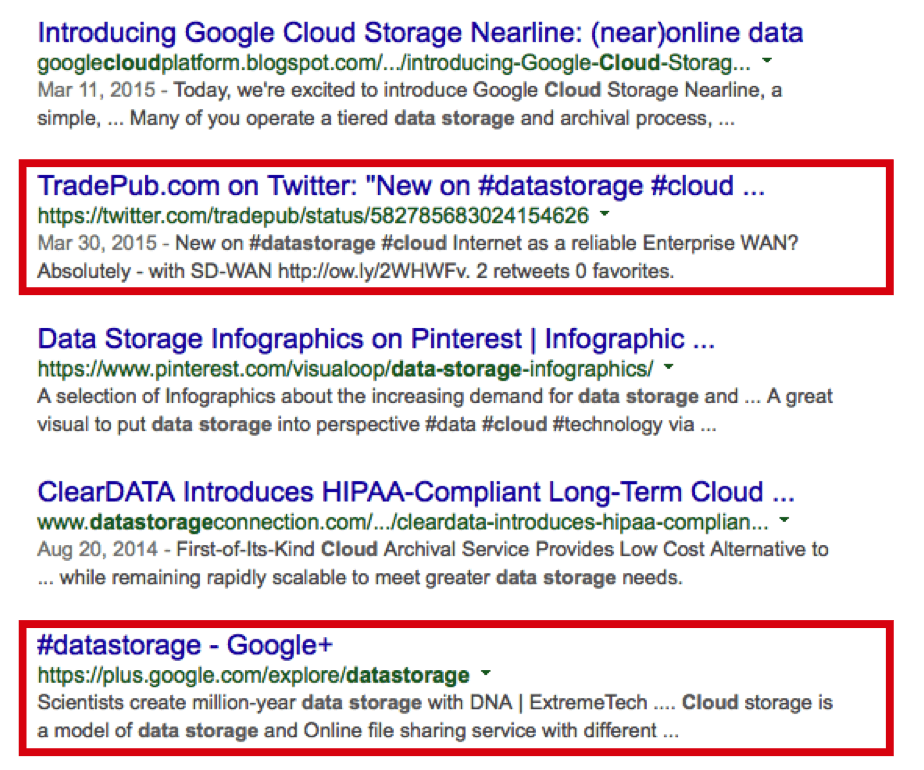
What is it? G+ posts from trusted authors are still showing up in the SERP. Combine a related hashtag, and posts from other social channels and key influencers can appear as well. Let’s look at an example:

Search Query: #datastorage cloud

Organic Results:

datastorage-cloud-serp

The first social listing (which is the second item shown) is a tweet, and the fifth listing is a link to the Google hashtag search tool. Google has gathered everyone who is talking about that particular hashtag and has displayed them in one listing. If your brand is striving for relevance within a certain niche, wouldn’t it make sense to add a relevant hashtag to your content?

Do these results show up if you omit the hashtag from the search query? No, there are zero social links.

Search Query: datastorage cloud

Results without Hashtag:

datastorage-cloud-serp-no-hashtag

A recent post from Ann Smart of Social Media Examiner outlined the value of Google+ posts with hashtags. Unlike other hashtag-enabled sites like Twitter, G+ actually curates content related to your posts. What that means is that they’ll serve up your posts in related searches. As Smart reinforces in her post, “It’s the additional related results that set Google+ hashtags apart.”

Your simple takeaway here is even if Authorship is dead, G+ should not be ignored. Use it, embrace it, and love it, especially combined with the use of hashtags.

Effective Hashtags Across Multiple Social Channels Can Improve Brand Visibility

One of Google’s most important factors for higher page ranking comes in the form of “the conversation.” This conversation is how people are connecting, discussing, and interacting with your brand. This factor comes in the form of the online currency of shares, tweets, +1s, likes, etc.

You can improve your own relevance in these conversations by embracing the hashtag. Even though this sounds like we’re beating a dead horse, don’t neglect the hashtag. Even Google has listed the hashtag as a search operator for improving results. Adding a hashtag strategy to your campaign will improve visibility for your brand, from Google to Twitter, Facebook, Instagram, and beyond.

Since our first search examples were dominated by Google and Amazon, let’s look at a keyword that gives other brands a chance.

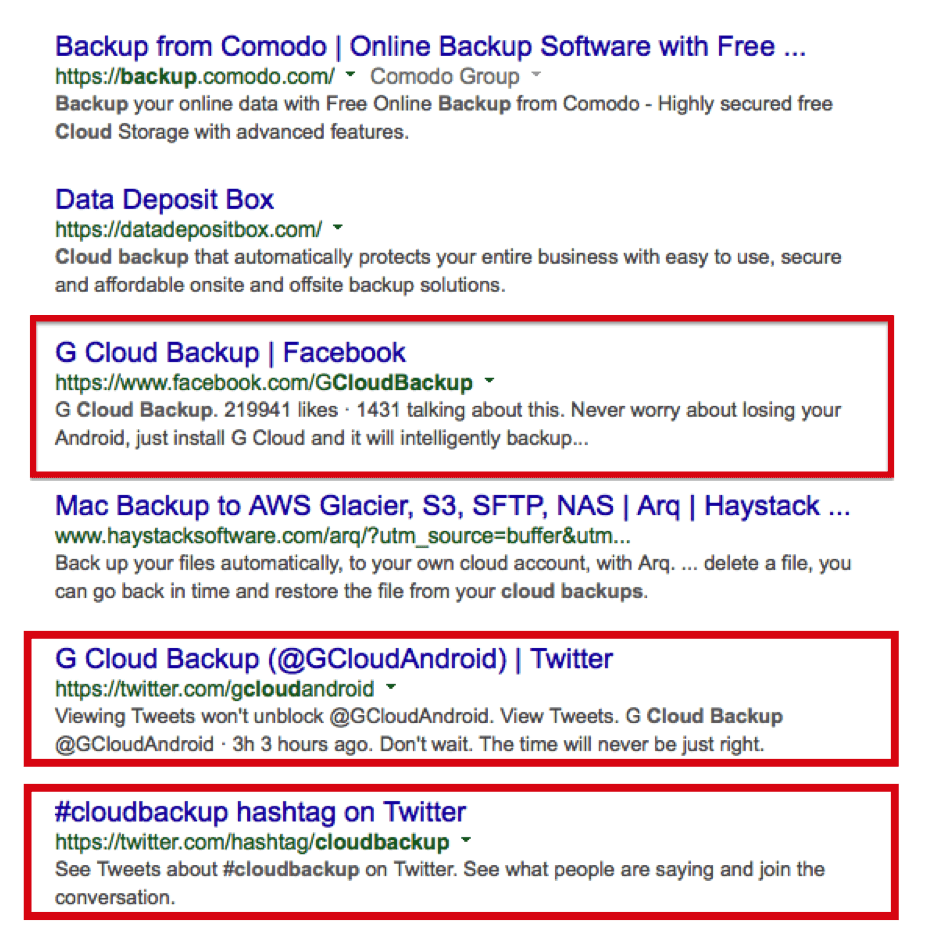
Search Query: cloud #backup

Organic Results:

cloud-backup-serp

Three of the top six results are social channels. As it gets harder and harder to achieve Page 1 results, perhaps it’s time to pay attention to WHO is showing up there, and build a relationship with them.

Remember the advice that came out after Google launched Penguin and Hummingbird? “Don’t guest post for links, guest post for an audience.” If your brand submitted a guest post for an authoritative source related to a specific hashtag, the value in the post would supersede “link juice” if their tweet reached Page 1, and the tweet linked to your post or your website.

Again, do results vary when the hashtag is dropped from the query? Yes, social links disappear, again.

Search Query: cloud backup

Results without Hashtag:

cloud-backup-serp-no-hashtag

Hashtags Make Your Brand A Bigger Part Of The Conversation

Using hashtags isn’t just about creating your own and hoping other people will catch on. It’s also about connecting with trends already present within the online and social media world and resonating with your own customer base or audience.

Search Engine Journal contributor Olga Andrienko brings this point home in a post she recently wrote:

“Using hashtags correctly makes you appear on-trend and tuned into current events. In other words, hashtags make you look relevant to your social media followers, and relevance is what makes them stick around.”

Hashtags and Google+: Your Ally To A Better SERP Result

The simple fact is that the more people talk about your company or brand, the better your ranking will get. Unifying your marketing campaign across social media using hashtags as the glue will bring it all together.

Your hashtag strategy should always start with Google+. Google explore tool gives you direct insight into topics and areas that are related to your most relevant industry topics. You’ll get a better understanding of what is being talked about online and how to be a better participant in that conversation. That connection will always get more people interacting with your brand online, give you insight on relevant groups that have captured your target audience, and contribute to your company’s inevitable ranking power.

Are People Searching With Hashtags In The Search Engines?

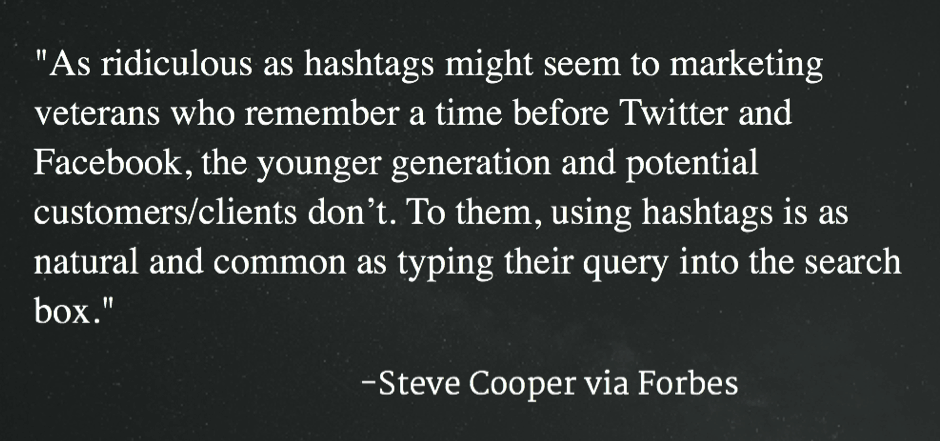
Google announced “a richer hashtag experience” for Google Search back in 2013, via Zaheed Sabur. Search Engine Land quickly followed up with an announcement of “hashtag search.” Kevin Lee from Buffer nailed it when he highlighted a quote from Steve Cooper on Forbes.com.

steve-cooper-quote

The hashtag. It’s time for marketers to use it and gain momentum over competitors who are still ignoring it and treating it as a fad.

About the Author: Markelle Harden serves as chief content manager at Get A Copywriter and creates Resources for businesses that are chipping away at their content goals. Follow her @getacopywriter.

This Cognitive Bias Will Help You Create More Persuasive Landing Pages

PSST: This post was written by Talia Wolf of Conversioner. You can see her speak at the Call to Action Conference in September – so get your early bird tickets now.

While we’d all like to think that we act based on reason and logic, the truth is that we have many cognitive biases that affect our decisions.

Back in 1974, psychologists Tversky and Kahneman were the first to theorize and research the anchoring effect: our tendency to rely too heavily on the first piece of information presented to us (the “anchor”) to make subsequent decisions.

Take the release of the original iPad for example. After Steve Jobs showed off the high-resolution screen and impressive features, he asked the audience how much they thought this “revolutionary” new device should cost.

steve-jobs-ipad

“What should we price it at?” asked Jobs. “If you listen to the pundits, we’re going to price it at under $1000, which is code for $999.”

He put a giant “$999” up on the screen and left it there for several minutes.

“I am thrilled to announce to you that the iPad pricing starts not at $999, but at just $499.” On-screen, the $999 price was crushed by a falling “$499.”

Bingo. Because of the anchoring effect, $499 is now considered “cheap.”

Understanding biases like anchoring helps us make sense of our personal decision making process, but it also helps us persuade our prospects and create more powerful landing pages.

Let’s dig into how brands and marketers are currently using anchoring – and how you can too.

Present the most expensive option first

As we saw in the Jobs example, when a higher price is presented first, it becomes the benchmark against which other prices are evaluated.

Joanna Wiebe of Copyhackers saw this first-hand when she ran an A/B test for her client’s pricing plans. The original page ordered the pricing from least expensive to most:

mad-mimi

Whereas the variation presented it in reverse, starting with the most expensive on the left:

mad-mimi-2

The verdict? The variation took the cake with a whopping 500% uplift in click throughs!

Because people read English from left to right, placing the highest price on the left ensured that people would see it first – making it the anchor against which to judge the price of the other plans. And that made the lower plan seem like that much more of a great deal.

The same effect can be achieved by comparing your pricing schemes to that of competitors. Consider this example by analytics tool Hotjar:

hotjar-example-anchoring

By showing potential customers how much they spend on a monthly basis for using a combination of tools ($265/month) versus how much they could be spending by using their all-in-one solution ($29/month), Hotjar positions itself as the product that offers the best value.

Use anchors to put things into perspective

So much of our decision making is governed by how information is presented. A $40 pricing plan might sound like a lot on its own, but using an anchor can help you put things into perspective for prospects.

Consider this campaign that agency Saatchi & Saatchi put together to collect donations and raise awareness for a worthy cause:

people-in-need-anchoring

In this example, the image grabs your attention, stands out and makes the immediate connection between the amount we spend on luxury items versus the small amount it costs to donate.

By showing people the amount of money they spend on their luxury items (the higher price) right above the low cost of the donation, they created a campaign that begged the question: “How can you spend so much on fashion but not be bothered to donate?”

Since 50% of our brain’s capacity is geared towards vision, the images we perceive on a landing page affect our emotional state. Images can communicate an idea, thought or feeling much quicker than text and can be used brilliantly with price anchoring.

Beware of negative anchoring

Anchoring isn’t a magic bullet. Sometimes, displaying multiple elements on your page can create an unwanted anchoring effect.

Have a look at the way Buffer displays their pricing plans:

negative-anchoring-1

As we’ve already covered, they may want to consider leading with the most expensive plan, but beyond that lies a greater issue. Once you choose a monthly plan, a popup comes up summarizing the amount you’re going to pay.

Suddenly, it isn’t the (reasonable) monthly plan you chose but a yearly payment of $2250.

negative-anchoring-2

The initial piece of information I received was $50 per month, but I didn’t get any indication that I was going to be charged annually. The large amount that suddenly appears on my screen comes as a complete shock.

To avoid negative anchoring, Buffer should consider testing the annual price on the pricing page. Why not inform people of the monthly price as well as the summarized annual price? It’d also be a great opportunity to present a discount to those paying for a year upfront.

At the very least, Buffer could test including a note about the annual billing under the call to action button, as on this landing page:

negative-anchoring-3

Wrapping it up

There are many different cognitive biases that have an impact on our decision making and purchasing patterns, but few are as impactful as anchoring. When used properly, anchoring can bring you dramatic improvements in your conversion rate.

To use anchoring on your landing page, pay attention to the initial information a customer is presented with when they land on the page.

  • First, set a goal. Which option do you want people to choose?
  • Then set up an anchor. What will make your goal look like the best possible choice?
  • Don’t forget to test, test, test. You want to be sure you’re not inadvertently creating a negative anchoring effect.

Over to you – do you use anchors on your landing pages? I’d love to hear about them in the comments.


Stay On Top Of Modern Marketing

Stay On Top Of Modern Marketing written by Guest Post read more at Small Business Marketing Blog from Duct Tape Marketing

“Youth Is the Engine of the World” – Matisyahu

Since I started writing my new book, YouthNation, last summer, the changes I have been studying have evolved in some instances more quickly than I could type. The groundswells from urban corners to suburban shopping malls are dictating the future of the American business economy.

Where would our nation be without Google, Facebook, Amazon, Tesla, or Twitter? Apple, a technology company, has the largest market cap on Wall Street and looks to be running away with that title. No longer do bellwether blue-chip titans hold the keys to our future. Instead, it’s a group of upstart millennial-minded organizations that are changing the face of communications, media, commerce, and transportation.

The problem is that there are still so many companies whose leadership is on the outside looking in. When I spoke at a conference of more than 200 digital marketers last month, I asked how many had heard of WeWork — a $5 billion company that’s changing the face of commercial real estate. Just two raised their hands. And this was an audience of professional digital marketers! Most of the rest of the country is even further on the fringe of this revolution.

In the 1960s and 70s, youth culture was counterculture, fighting big business and big government in an effort to be heard. They had to protest in big groups and stage be-ins and other happenings to effect change. The seminal event of that counterculture, Woodstock, attracted what was, in 1969, a mind-blowing 400,000 people. The Electronic Daisy Carnival draws more than that to Las Vegas Every Year. The power of youth in sheer numbers, share of voice, and macroeconomic impact is greater today than ever before.

So what can you do, as a modern marketer, to stay on the right side of disruption? Here are a few modest suggestions:

  • Change the way you consume news: Curate your news from those who you respect, using tools like Nuzzle, which aggregate the headlines that are shared by the people you follow.
  • Learn about emerging startups. Attend conferences and read blogs to keep abreast of companies like the aforementioned WeWork, Kickstarter, Postmates, and so many others, which are disrupting fabled industries that have remained static for nearly a century.
  • Search platforms like Skillshare where (very inexpensive) classes can keep your skills fresh in shifting areas such as search engine optimization and mobile design.
  • Choose your sources wisely. Increasingly, traditional media sources are becoming also-rans, as the most important news is broken by platforms like Mashable, and by influencers who are close to the industries being affected.
  • Learn the new social platforms, even if they seem silly at first. If the first wave was Facebook, Twitter and LinkedIn, the second wave is Instagram, SnapChat and Pinterest. Doing a deep dive and using them actively will enable you to fully understand these tools, and will spark ideas on the ways your business can use them.

Yes, the world continues to change, and for many, the changes are scary. But the new forces are easily accessible, so you are now more empowered than ever before to harness these changes and catapult your business to new heights. If you’d like to go deeper, YouthNation may serve as a roadmap.


Matt_Britton_72_DPIMatt Britton is the founder and CEO of innovative ad agency MRY, and the chair and co-founder of @CrowdTap, the people-powered marketing platform. On Twitter, he’s @MattyB.